“I’ve read Barron’s for 50 years. In 50 years, I found one investment opportunity in Barron’s, out of which I made about $80mn, with almost no risk. I took the $80mn and gave it to Li Lu, who turned it into $500mn. So I’ve made $500mn out of reading Barron’s for 50 years and following one idea. I didn’t have a lot of ideas. I didn’t find them that easily, but I did pounce on one.”
Charlie Munger, 2017 Daily Journal Shareholder Meeting
This well-known quote describes a small 2001 investment Charlie Munger made in a “little auto supply company” that turned out an 8-bagger over three years. Had he held the stock a few years longer, it would have been a 20-bagger.
Note the “almost no risk” claim of the quote. I want to debunk that before we move forward.
Tenneco was a highly risky investment, though one with a mouthwatering risk/reward proposition. It had a great edge, but without hindsight, assessing its odds would be difficult. Given its outcome, the investment was cheap, with the margin of safety inherent in the share price, but this wasn’t a stock you could plow a significant portion of your bankroll into. Remember the Kelly criterion. Munger was already a billionaire by the time he bet single-digit millions of $$ on it.
The same principle applies to the stock I’ll introduce to you today. It’s a high-risk, even higher reward play with a heavily asymmetrical wager. It has so many traits in common with Munger’s Tenneco investment that it’s hard not to be on the edge of my seat.
But before I introduce the stock, more on Tenneco:
Munger claimed he spent less than two hours deciding to invest in Tenneco, calling it a cigar butt. Here lies an important distinction between how munger defined a cigar butt and how Buffett defines it. Unlike Buffett, who, by Ben Graham’s teachings, thinks of cigar butts as businesses where you can shut down operations for one last “puff,” with the return inherent in the liquidation value exceeding the price paid for the entire company, Munger, at least in the case of Tenneco, defined a cigar butt as an incredibly cheap stock, strongly protected by sticky earnings.
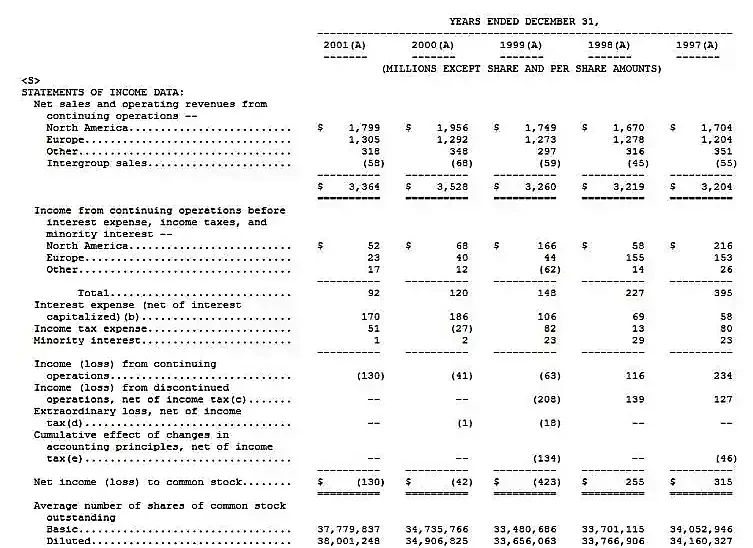
In fact, Tenneco had no liquidation value. Tangible equity was negative due to large accumulated losses and treasury stock. The company had $1.6bn of book debt with an average interest rate of 10.3% in 2001. Of that, >$1bn consisted of senior credit facilities, mostly bank loans, where Tenneco had already breached two of three covenants and was close to breaching the third by the end of 2001. The company had renegotiated covenant relaxations three times between 2000 and 2002 in exchange for higher interest rates, and creditors forced it to factor receivables to remain in good standing. The remaining ~$500mn of debt consisted of 11.625% subordinated notes due 2009, trading at a 35% YTM — Munger bought those too. Operating income had dropped from $227mn in 1998 to $92mn by the end of 2001, with net income burdened even more by annual recurring restructuring charges. The dividend was suspended in 2001 and wasn’t reinstated until 2017. With a fully diluted market cap of $51mn and net debt at a market value of $1.2bn, the equity was trading as if the company were headed for bankruptcy.
Here’s Tenneco’s income statement from 1997 to 2001:
And balance sheet from 2000 to 2001:

Tenneco was undeniably a risky investment. At its lowest, the share price plummeted to $0.66, just one-third of Munger’s purchase price. On an EV basis, the stock didn’t even look that enticing given the risks, trading at 6.5x EBITDA and 13.9x EBIT for 2001 — a pricing weighed by a 4% operating margin, sluggish growth, and average cost of debt >10%. Tenneco faced heavy customer concentration, with nearly 50% of its sales tied to just four car and truck manufacturers. Meanwhile, aftermarket distribution channels were consolidating around Autozone and Advanced Auto Parts. The company was increasingly selling into concentrated horizontals in a mature industry, with limited pricing power. And with the US in a recession, new vehicle sales declined by 1% two years in a row, disproportionately hitting auto parts manufacturers like Tenneco, burdened by operating leverage and a fully unionized workforce.
But the equity offered a massive swing factor due to its heavy leverage if things just turned out okay. Price-to-sales was a mere 0.015x. The equity was essentially an option bet on solvency.
Munger saw a few things that tilted the odds in his favor:
- He knew how sticky some of the secondary auto market was and the enduring demand for Tenneco’s Monroe shock absorber. (The Barron’s article noted that Tenneco held the number-one position in shock absorbers, commanding a 52% US market share for ride control products.)
- Management was doing everything it could to downsize leverage, closing numerous plants and laying off workers.
- Operations generated sufficient cash to service the debt.
Tenneco generated $234mn in 2000 and $141mn in 2001 of cash from operations — enough to cover interest expenses. Most of this cash release came from stretching payables in 2000 and cutting down inventory in 2001. By 2002, the economy began recovering, the Fed cut interest rates, and reversion to the mean kicked in, with Tenneco generating $169mn in operating profits in 2002, followed by $174mn in both 2003 and 2004. From 1998 to 2004, FCF averaged >$100mn annually, double the market cap by the time Munger invested in 2001. Tenneco benefited from leverage and debt refinancing, with all gains flowing to the equity stub. The share price soared to $15 by late 2004 when Munger sold. The debentures rose to 107 and were called.
It took 50 years of reading Barron’s every week for Munger to find the Tenneco investment. The best ideas arrive seldom. By placing asymmetrical bets when they appear, even small wagers like this can multiply wealth at astronomical rates.
There’s another Tenneco out there today. The parallels are striking. It’s a risky, levered case — both financially and operationally — but it boasts a clear debt-paydown catalyst and trades absurdly cheap. It’s either a zero or a multi-bagger.
Let’s jump in.