
This is the gist of FILA’s investment case:
FILA, an Italian branded stationery (for kids, office workers, and artists) manufacturer, owns 26% of its Indian lower-end equivalent, DOMS Industries. This stake has a EUR-equivalent at-market value of EUR386mn. FILA itself trades at a EUR470mn market cap and has EUR255mn of net debt plus EUR4mn of NCIs, for an enterprise value of EUR729mn. So if you remove FILA’s DOMS stake (booked via the equity method at EUR143mn) as a non-operating asset, the market currently prices FILA’s operating assets at EUR343mn. For reasons I’ll explain later, since cash flows are highly seasonal in this business, FILA will likely generate some EUR70mn of free cash in Q42025 alone, putting pro-forma EV at EUR659mn and thus the implied value of the operating assets at EUR273mn. This is for a business that in the TTM earned EUR73mn of EBIT, putting the multiple on FILA’s core business at 3.4x. This is cheap for a century-old, vertically integrated, fairly predictable business with defensible global market share (20–60% for its main brands in their key local markets), having earned >10% EBIT margins for more than a decade. The only real catch is that DOMS trades at nosebleed levels in the Indian market, but FILA isn’t constrained by any lockup and could sell anytime it wants.
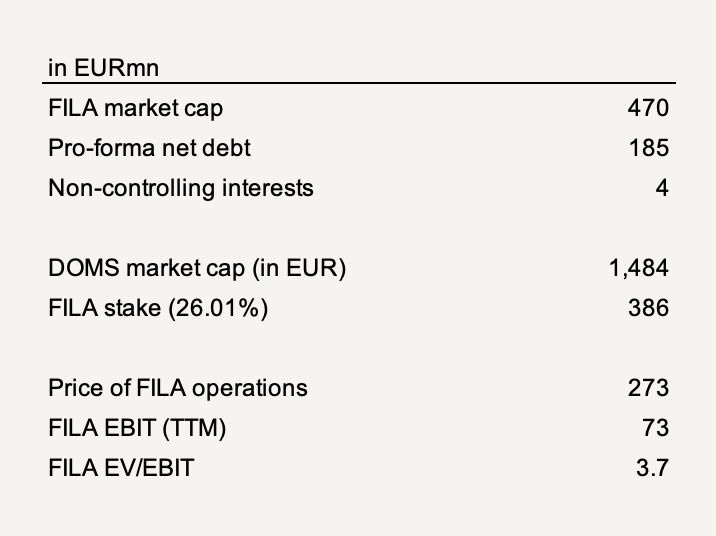
As there are several writeups on FILA out there on the internet — the stock has gone from overlooked to picked over by small-cap value investors — you might wonder what it is I think I add to the literature. The answer is that while I recognize that FILA is cheap, I’m not so sure it’s as mispriced as other writeups make it out to be, and I’ll explain why behind the paywall.
My view is backed by two other reasons:
- The writeups I’ve read on FILA all seem to (conveniently) leave out the fact that the company has a non-negligible amount of debt for a slow-growth (currently no-to-negative growth in real terms) business with cash flows that are heavily impacted by large swings in working capital running at >40% of sales. This debt levers the upside for the equity in the case of a rerating but also increases the risk of an off analysis. One writeup I’ve seen uses P/EBITDA as a nonsensical valuation metric, and another uses management’s guided FCFE to show that the equity stub trades at 1x FCFE, concluding that it must be extremely cheap. But P/FCFE (and please never use P/EBITDA unless the firm’s net debt position is exactly zero) is an optimistic shortcut for a levered business. If you subtract the DOMS stake from FILA’s pro-forma EV, then add back full-year financial expenses (net of the tax shield) to FILA’s EUR40mn guided FCFE for FY25 to get to FCFF, you arrive at something closer to 5x FCF for the enterprise. Cheap, but much more sensible to me, considering the swing factor of the DOMS stake, compared to what other writeups make this out to be.
- Most of these writeups focus on FILA while superficially analyzing DOMS. But SOTP (or NAV) analysis is bonkers if the underlying assets are massively overpriced. FILA’s DOMS stake makes up ~60% of FILA’s pro-forma EV, so it’s obviously important to focus attention on the DOMS business. DOMS’ future looks bright, while FILA’s core business is in a no-growth industry with challenging demographics, certainly in Europe. (The smaller “fine arts” segment might benefit from an ageing Western population, so it is slightly better positioned.)
These points take little away from the fact that FILA does look cheap here, but the investment case is almost entirely dependent on how management intends to allocate capital over the next few years. It’s important to get the analysis straight. I already gave the core of it in the introduction, so the following are my expanded thoughts, starting with DOMS: