
Here’s part 1.
Given how hard the investment game is, the only thing fully under my control is what I spend time on. Filtering is the front line of the process. If you get that wrong — if you spend your day reading the wrong things, fishing in the wrong ponds, or obsessing over the wrong variables — everything downstream gets worse.
My way of dealing with that is simple: I rely heavily on routines. Oscar Wilde once said that “consistency is the last refuge of the unimaginative,” but I don’t think that’s true in stock picking. For me, routines make the imaginative part of the job possible.
Let me start by going over my daily routine, one I’ve settled on after years of trying to optimize for it.
My typical day starts with taking in information that widens, rather than narrows, my surface area. In the morning, I read four publications: Børsen (Denmark’s “FT”), the FT, WSJ, and The Economist (a handful of random articles from the weekly). I pace through them and try to cap my newspaper reading to 90 minutes. I read to absorb general knowledge about what’s happening in business and the economy, bits of data I can hang onto whatever else I’m working on that day. But my mind is also scanning for anything that might create a temporary dislocation, like mergers, spinoffs, or weird restructuring news.
After that, I check my email to get rid of practical stuff but also to skim through newsletters and Google Alerts for keywords I set up for the names in the portfolio, their peers, and corporate events like, but not limited to, the following (for a full list of my corporate event alerts, feel free to reach out):
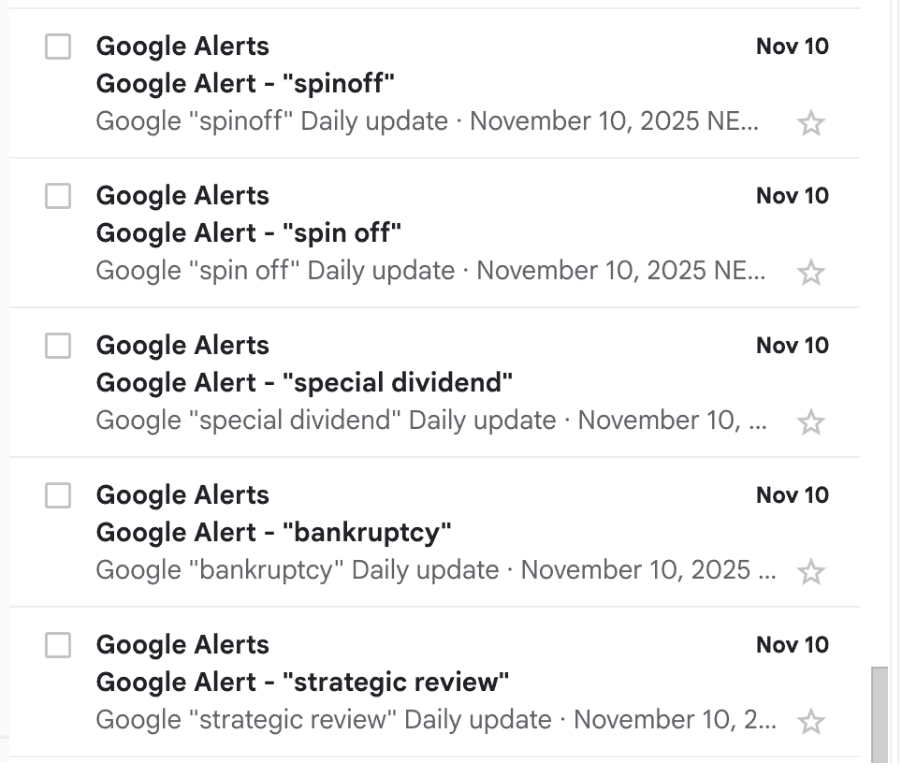
I prefer Google Alerts (which is free, btw) to any other news aggregator you’d get on your phone or paid terminal. You decide the keywords, and Google surfaces anything that hits those keywords daily, whether it’s a small local paper or a trade magazine in German. A quick tip if you wanna use it: set the region to “any region”, and for foreign companies, set the language to “any language.”
Once I’ve dealt with that, I’ll usually make a pass through X and Substack. I’ll check Value Investors Club and the Corner of Berkshire and Fairfax message board too. I don’t treat either as primary information sources. They’re more like a noisy, occasionally useful layer on top. Every now and then, someone will flag a quirky little situation or an obscure company worth a look, and it’s helpful to see what thoughtful people I follow are chewing on. But I try not to confuse scrolling social media with real work. If I’m still scrolling at 11am, something has gone wrong.
From there, I move into what I think of as the “market scan”. I’ll open Koyfin and look at prices and movers. I start with the watchlist to see if anything has sold off sharply, but I’ll scan everything else too — highs/lows, indices, exchange rates, commodity prices, interest rates — even stuff outside my immediate focus to get a feel for the temperature. The point is to maintain context about financial markets, helping me stay aware of the background noise that can distort perception.
After that, I’ll go through more corporate event feeds like stockanalysis.com InsideArbitrage, stockspinoffinvesting.com, Finviz’s insider trading tracker, or my broker’s corporate action tracker to make sure I’ve covered most grounds as it relates to special situations. I also keep my own spreadsheet, logging corporate events I read about on the go. I look at everything, like insider buying, rights issues, spinoffs, delistings, mergers, liquidations, and so forth. Sometimes, I’ll head to sec.gov too and search for stuff like “strategic review” and scan through fresh 8-Ks, 6-Ks, and proxy materials. The majority of situations are uninteresting, but every so often one stands out, either in terms of a forced seller, a technical overhang, or a situation just awkward enough to be mispriced. A surprising number of interesting situations start life as a dry notice: a tiny spin, a quietly announced wind-up, or a strange little merger. These things rarely make the news flow in any prominent way, but they can serve as great ways to catch a lead.
By now, the time is somewhere between 10-11am (usually closest to 11am), and I’ll move on to a ritual I call “stock sprints.”
A stock sprint means going through a batch of stocks quickly, without pre-screening. I’ll pick an exchange or country and start alphabetically, spending anywhere from a few to 15 minutes on each stock. For each stock, I’ll pore over the financial statements (focusing on the balance sheet), understand what the company does and how/from whom it makes money, look at the latest PRs, and read the shareholder letter. I’ll take a long-run financial view of the company and look at its stability (focusing mostly on the gross margin), scan for loss-making/cash-losing years, and look at inflection points like CEO changes, capital raises, special dividends, or tender offers, and what happened at the time. For each stock, I’ll also think about whether technology is going to help or kill it. The goal is to build pattern recognition by seeing enough names that my mind not only starts to connect dots between different companies and industries, but also starts to notice anomalies. I want to familiarize myself with, and not necessarily build a view, on every company. It’s about developing the ability to say “no” quickly while still leaving room for the occasional “wait a second.” I’m looking for things that jump out and hit me over the head with a baseball bat: strange capital structures, stubbornly profitable niche businesses, balance sheets with large non-operating assets, net nets with steady margins, or special sits where the outcome is tightly framed. The details get filled in later. At this stage, I’m just flagging asymmetry.
I usually filter out the following right away:
- Large, persistent losses with no clear path to self-funding.
- No revenues or “pre-revenue” stories where the thesis lives entirely in the future.
- Chronic lack of cash flow, especially when combined with promotional communication.
- Substantial debt or messy capital structures where a mild downturn could force dilution on bad terms (though this one obviously has exceptions, as there are companies that become mispriced precisely due to their messy capital structures).
- Past associations with fraud and dishonest insiders.
These points are particularly important in microcaps (the pond I like to fish in), where there are many ways to get hurt. A common trap is the obsession with catching a 100-bagger, framing every idea as something that must grow from microcap to midcap to be worthwhile. That doesn’t mean you shouldn’t swing for an XPEL once in a while, but it’s generally a mindset that pushes people to take on more risk than they understand, to rely on heroic growth assumptions, and to ignore the balance sheet.
What I actually want at this stage is much simpler: businesses where the level of foresight required to make money is low.
Intelligent forecasting is, in my view, a useful tool for highlighting potential obstacles and opportunities, but shouldn’t be the primary basis for an investment. Even managements’ abilities to predict earnings are universally poor.
This means I prefer these kinds of setups:
- Low multiples on normalized earnings power.
- Net cash and a tangible balance sheet you can hang your hat on (but both of these have exceptions).
- Business models where lots have to go wrong before I lose much, and only a few things need to go right for me to do well.
Aswath Damodaran has said that the real challenge in valuation isn’t finding a more elaborate model, but dealing with uncertainty. 90% of uncertainty is macro and outside your control. No amount of homework or spreadsheets makes it go away. Our natural reaction is to add more detail to the model, which fallibly increases confidence without improving accuracy. I try to resist that by keeping valuations as parsimonious as possible, especially at the filtering stage.
A microcap trading at 6x owner earnings, sitting on a net cash balance sheet, and run by honest, reasonably aligned insiders doesn’t need any growth to be an excellent investment. A 17% earnings yield, some cash returns over time, and modest multiple expansion can combine into nirvana. If growth shows up on top, great. If it doesn’t, you’re still fine. I find it much more useful to think about the downside first. If you buy things sufficiently cheap on today’s reality, the multi-baggers have a way of appearing on their own, without you forcing it.
Within that framework, there are a few patterns I pay particular attention to during a stock sprint:
- Untapped pricing power. Every once in a long while, you come across a business that could materially increase its returns by raising prices, but hasn’t. The customer dependence is already there, and management just hasn’t pressed the button yet. That’s the ultimate no-brainer, if the other pieces (balance sheet, culture, incentives) line up.
- Fixer-uppers with something sound underneath. The business is great but temporarily buried under a pile of self-inflicted problems or one loss-making segment. The question in these cases is whether, if you cut away the folly, there’s a healthy core that can stand alone and whether management will do enough resource conversion to crystallize it.
- Multiple layers of margin of safety. I want situations where, even if I’m wrong on one dimension, there are other layers of protection. The whole point of a margin of safety is to make precise forecasting unnecessary. As I pace through stocks and crack open the reports, I make three ballpark calculations of value: liquidation value, asset reproduction value (what it would cost to rebuild the business), and earnings power value. The more value I can get in each layer for the price of the stock, the sturdier the idea.
A stock sprint routine sounds tedious, but it’s where most of the edge comes from. I can’t control market direction or sentiment, but I can control my surface area, the number of stones I turn over, and the regularity with which I do it. Filtering is the compounding mechanism. If I spend years looking at thousands of stocks and reject almost all of them, my intuition for what “normal” looks like, what’s mispriced, and what’s odd gets sharper.
(As you’re probably wondering, I do use stock screens once in a while. I use two simple ones: One that screens for net nets, so NCAV > market cap, and one that screens for high gross profitability, so gross profits scaled to tangible assets, then sorted by the lowest EV/sales. Stock screeners are one way to get tunnel vision, which is why I tend to move up the income statement.)
I usually spend a couple of hours on my daily stock sprint. So it’s now past noon, and I’ve probably written down a small handful of mildly interesting names on my kanban board from all of the morning’s activity. The rest of the day is then spent diving into each name on my ever-growing list (my kanban grows faster than my ability to clear it, which is probably how it should be). Most ideas never make it past the “interesting” stage. They sit there for a while, get revisited, and are eventually deleted when something better comes along. The goal isn’t to process every name but to maintain a living backlog of potential work, a record of things that at one point made me pause.
The afternoon of my day is when most ideas die. This is when I dive deep, read everything in sight, and write while I research. I’ve made it a habit that I have to read at least one full 10-K/annual report front to back every day, since it’s the job no one wants to do, and it forces me to always focus on primary sources first. A lot of people rest their investment decisions on secondary sources, like tips, sell-side notes, or social media. But if you start with someone else’s map, you inevitably see the company through their lens, and if you think the solution to dealing with uncertainty is to outsource thinking to someone else, you won’t take responsibility for what goes wrong in due time. Reading the primary documents forces you to build your own mental model from the ground up. It’s slower, but it’s better.
I’ll explain how I dive into a stock in part 3.
There are two points about my daily routine:
- I take my self-training very seriously. The process is the point. Most of my day is spent reading, writing, and thinking. You can probably tell I don’t slot in much time for meetings or calls. This is a solitary game, and you have to be comfortable with that. There are more aspects to my self-training routine, like how I practice memorization and recall, but I’ll save that for part 5.
- Ideas come from everywhere. Some arrive through deliberate work, but others show up by accident. The important thing is to stay open and curious enough that when something interesting crosses your desk, you actually notice. This is also why writing matters more than it seems. One of the underrated benefits of putting work out in public is that it invites serendipity. Smart subscribers send things over, and it helps that I offer a one-year free subscription for genuinely good ideas. (If you think you have one, you’re always welcome to send it.) This forces me to close gaps in my understanding and leads me into corners of the market I wouldn’t have found alone.
Stick around for part 3 of my investment method, which I’ll send later this week. And if you know someone who might enjoy this post, feel free to share it by clicking the “share” button below!
Cordially,
Oliver Sung