At night, while you’re tucked snugly under your duvet, Lindbergh’s truck drivers work quietly in the dark, orchestrating a silent symphony to ensure swarms of field service engineers across Italy can work efficiently by daybreak.
Take Giovanni, a field service engineer working for a multinational OEM like Jungheinrich, Atlas Copco, Kone, or Schneider. He’s mid-job, fixing a compressor, forklift, or elevator, when he realizes he’s missing a critical part. It’s 4 p.m., Giovanni needs the part by morning to stay on budget, and his employer is price-insensitive. He knows DHL won’t bother delivering a single part overnight. Besides, how’s he supposed to meet a courier when his workday is winding down?
Luckily, DHL doesn’t cross Giovanni’s mind, because Lindbergh saves the day. Using Lindbergh’s proprietary software, T-Linq, Giovanni orders the part, confident it’ll arrive by 7 a.m. at the latest. And while he’s at it, why not have Lindbergh collect the few kilos of chemical waste he’s accumulated, handle the disposal paperwork, and take it away? Better yet, why not leave his oil-stained workwear in the van, let Lindbergh drop off fresh garments with the spare parts, and haul the dirty laundry back for cleaning? And those protective gloves he’s running low on? Toss in a few extra. And hey, his tools need recalibration for quality inspection — why not hand those to Lindbergh’s driver too, letting its specialists and certified equipment handle it?
You might wonder how the hell a truck driver pulls this off while Giovanni snoozes. You guessed it: Lindbergh already got a copy of Giovanni’s van keys, trusted to secure deliveries in his parked vehicle in his driveway overnight while picking up whatever add-ons he’s ordered. And the spare parts? Picked up straight from Giovanni’s employer’s warehouse, to which Lindbergh also got access.
It goes without saying that this is not a run-of-the-mill, ordinary logistics model. It’s barely logistics at all. It’s a trust-based service business, niche as it gets. As Lindbergh’s FY21 annual report puts it:
“We like to say that logistics is not the ultimate goal of our business, but ‘only’ the means through which we want to do business and create value for ourselves and our customers.”
Two points hit me while reading about this business:
- Imagine the customer onboarding and rapport a setup like this must have taken.
- Imagine the lack of competition a business like this must have.
A client contract like this takes serious integration, planning, and pilot programs to build trust. First, tiny Lindbergh has to waltz into boardrooms of typically massive multinational clients and convince them to let hundreds of their field service engineers hand over their van keys for Lindbergh to duplicate, distribute across far-flung regions, and return the originals without a hitch. In Italy, where bureaucracy and union negotiations move at a glacial pace, this alone can take months. Then, the service catalog gets tailored to each client. Afterwards, there’s the tech: T-Linq is pitched as user-friendly, requiring minimal training for engineers who’d rather be in the field. But syncing it with a client’s ERP — often a patchwork of on-prem legacy software — is a headache. Real-time updates for deliveries and warehouse movements sound great, but pulling it off means wrestling with APIs and endless configuration. Then comes the pilot phase, typically a couple of months, testing Lindbergh on basic spare parts delivery — often at a loss to prove its chops — before layering on value-added services like waste management.
The whole process can take upwards of a year, with another half-decade to fully onboard a client’s entire fleet of engineers. It’s a marathon, not a sprint, so once everyone’s happy and through the hoops, Lindbergh gets increasingly woven into the client’s operations, locking in multi-year contracts with automatic renewals. That’s the whole game. Trust is the bedrock, and Lindbergh knows it can’t be rushed.
Only then does Lindbergh start capturing value for itself, while delivering 3-4x more value to the client. For clients, small bottlenecks — like Giovanni chasing parts, disposing of waste, or washing uniforms — pile up into a massive drag on cost and productivity if handled in-house. A single day of non-core tasks for an engineer like Giovanni may eat up 5 hours a week, costing €300 if assuming Giovanni is paid €60 an hour. Of that, the client might pay Lindbergh €100 for three or four nightly deliveries with add-ons (roughly €5-10 per service), yielding a 3x willingness-to-pay-to-price (WTP-to-price) ratio. That’s before factoring in intangibles like the goodwill the client earns with the end customer from finishing jobs faster. As Lindbergh stacks on more value-added services, the WTP creeps up, giving Lindbergh pricing power to support consistent mid-single-digit percentage price hikes. Coupled with the fact that MRO services is a defensible business, resilient through economic downturns (partly by law; you don’t stop servicing elevators in a crisis), and that Lindbergh’s take is just a low-single-digit percentage of clients’ MRO revenue (Jungheinrich pays Lindbergh 2-3% of its high-margin MRO revenue), the moat here is deep with minimal risk of squeezing clients. Case in point: in 2021, Jungheinrich tapped Lindbergh to fully manage its forklift warehouses, prompting Lindbergh to add a whole new business segment (which later consolidated into the core business).
With a clear value prop for large OEMs — and less so for small technician teams of just 3-4 engineers — tiny Lindbergh has bagged an impressive client roster:
- Jungheinrich, STILL, Linde, Toyota, and Mitsubishi in forklifts,
- Atlas Copco and Kaeser in compressors,
- Kone, Otis, and TKE in elevators and escalators,
- plus Liebherr, Schneider, Ricoh, LKQ, and LVMH (which I’ll get back to).
These were largely convinced through direct scouting and word-of-mouth. And while this makes the business heavily concentrated in a small number of clients, with the five largest accounting for some 2/3rds of segment revenues, the client churn is a round nil. There’s never been customer churn in Italy. Jungheinrich, likely over 25% of segment revenue, has been with Lindbergh since 2008 through three service director changes. Linde has been on board since 2010. Half of Lindbergh’s clients have stuck around for over a decade, despite contracts running 3-4 years with automatic monthly adjustments tied to diesel prices or inflation. And as for end customers, these are mostly locked into the OEMs themselves too, restricting equipment maintenance to the OEMs’ technicians who possess the right spare parts and know-how for reliable, mission-critical service work.
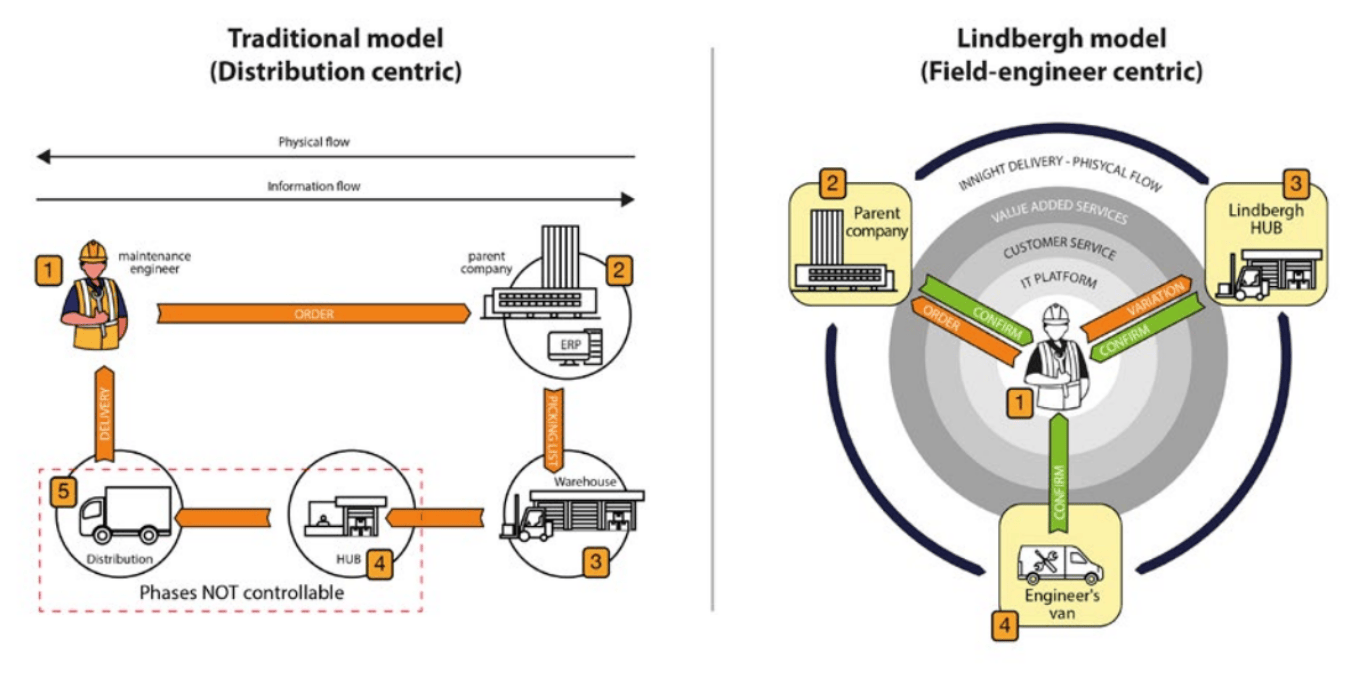
Now, take that 3x WTP-to-price ratio and consider Lindbergh’s near-empty competitive landscape. The unbeknownst eye to what Lindbergh really does may dismiss Lindbergh’s ~€25 per delivery (or some €35 with stacked services) as steep compared to the €15 or so from traditional couriers like FedEx and DHL. Yet, as established, this is a different value proposition, with the field engineer-centric model in stark contrast to the distribution-centric model of traditional logistics players. Standard couriers thrive on high-volume, low-complexity deliveries, leveraging scale from route density and prioritizing max deliveries per driver, often in ring-fenced territories without fancy routing software. That works for bulk shipments but flops in the intricate, time-sensitive world of field service engineers, where a few critical parts must hit scattered vans overnight. Because they’re wired for volume, traditional couriers see little appeal in small-batch, dispersed deliveries paired with regulatory headaches.
In fact, TNT, owned by FedEx, once offered in-night delivery and dominated the market, but the segment was a rounding error in its books (Swiss Post’s in-night deliveries, for example, are <0.5% of total revenue), even with a distinct operational setup and plenty of headaches. Lindbergh saw field service engineers becoming an afterthought and stepped in for TNT’s customers when TNT bailed them. For a courier like TNT to re-enter now would mean rebuilding a specialized network from scratch — costly and risky against Lindbergh’s entrenched moat. Add the regulatory complexity of waste management in Italy (or the EU, frankly), where certifications and compliance take years to secure — not to mention for the warehouses themselves — and the hurdle’s just not worth it. Waste management facilities eyeing downstream face their own barriers too, since, as they’re optimized for high-throughput industrial or municipal waste, they have little incentive to chase tiny, scattered volumes where a year’s micro-waste equals a day’s intake at a single facility.
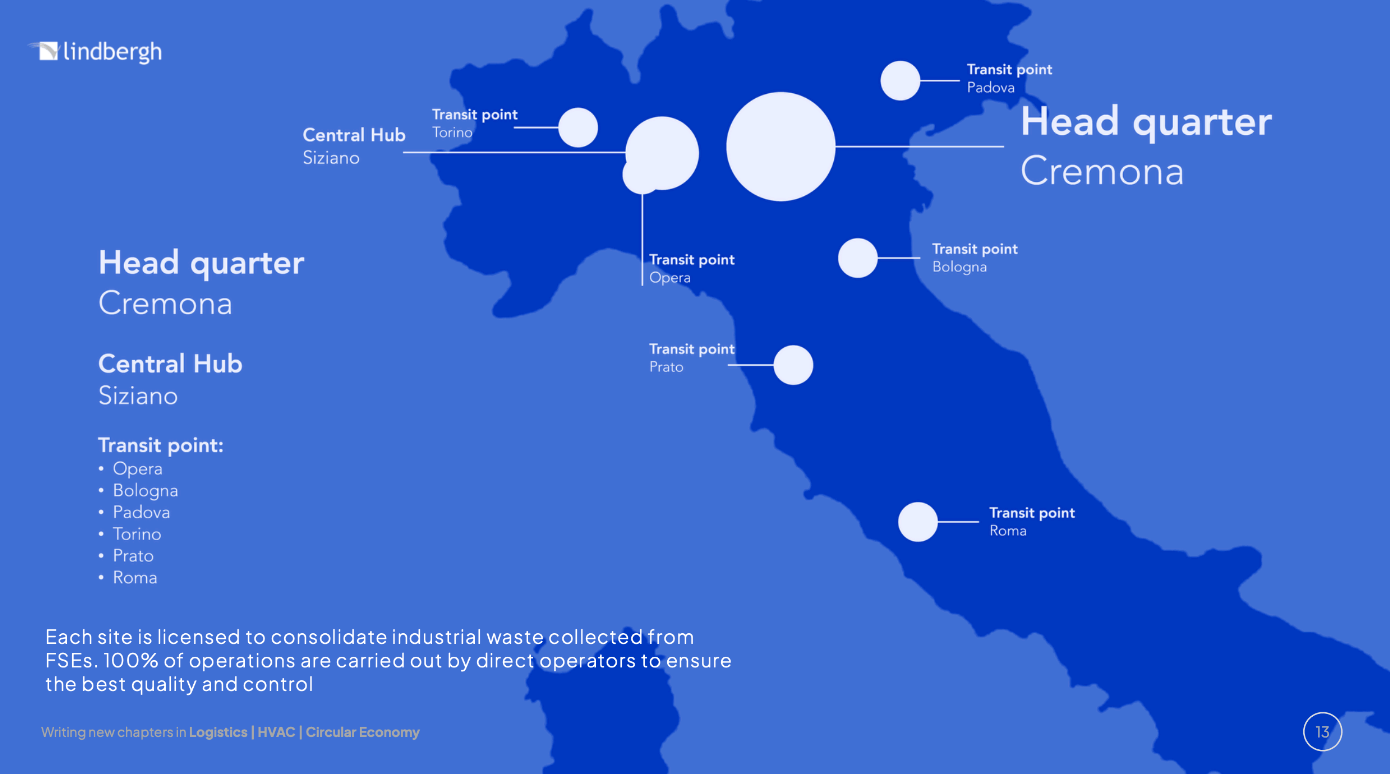
But even as cost advantages from scale economies — running lots of volume across high fixed costs — are usually best suited for homogeneous offerings that share a common process, Lindbergh still has route density going for it. Its vans, network of 120+ specialized subcontractors for micro-waste, and licensed consolidation points and warehouses (storing micro-waste and inbound parts from clients’ warehouses) cover nearly all of mainland Italy, with route optimization done all through Lindbergh’s proprietary software.
By far the kicker, though, is the incremental margin on value-added services. As you can imagine, with significant staff and transport costs on a gross margin in the low-30s% (contracts typically guarantee 30% for the logistics and 35-40% for waste management), a niche business like this can’t be profitable just from dumping small spare parts packages into engineers’ vans across towns and valleys. But service add-ons stacked by the client have juicy incremental margins with little to no capital investment. Delivery costs don’t scale with services offered, which lets Lindbergh’s margins climb with the duration of the client relationship. Such scale economies, akin to the likes of Cintas, erect high barriers to entry and allow Lindbergh to earn an EBITDA margin more than 1.5x that of traditional couriers.
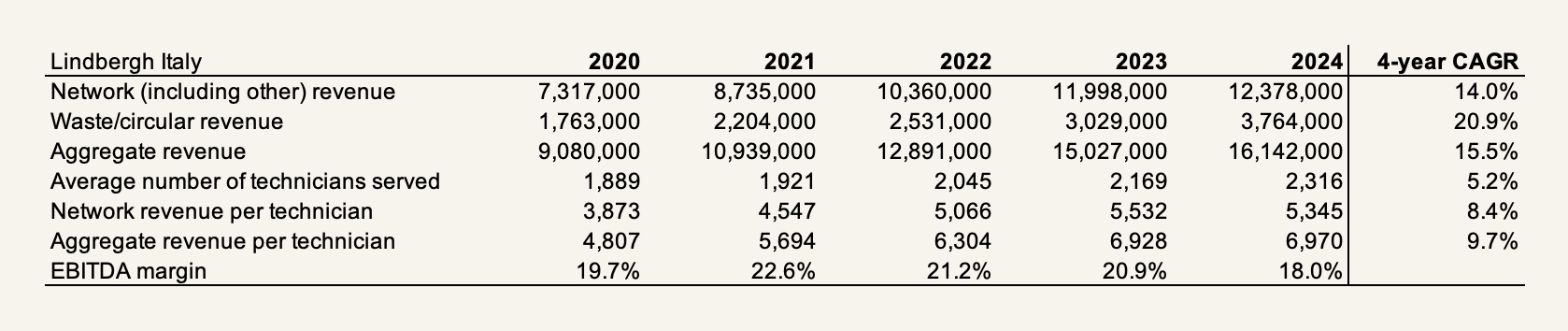
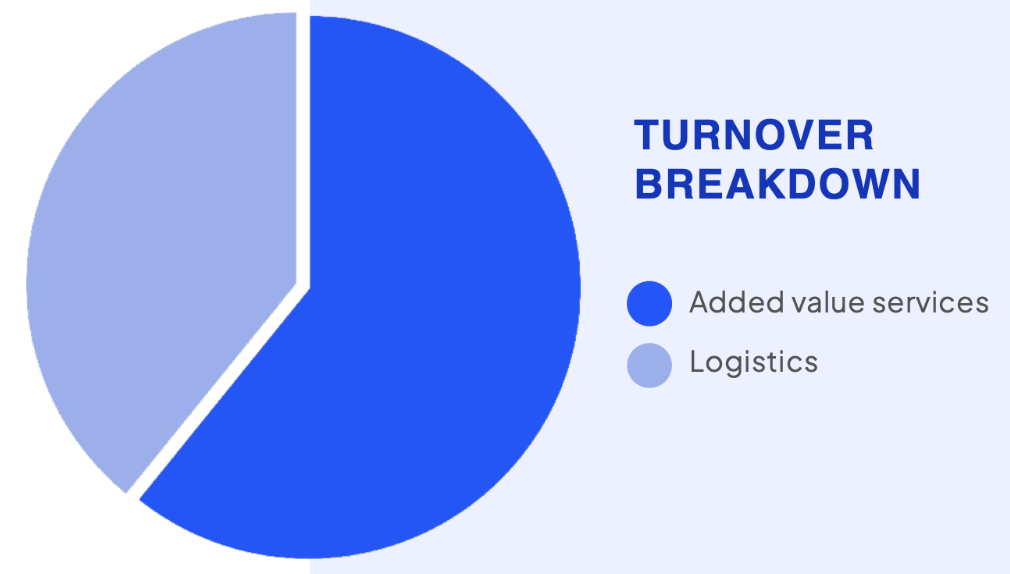
Technically, Lindbergh divides all of what I described so far into two segments as indicated above: “network management” and “waste/circular economy”, with the reason being that the latter accounts for future circular economy projects that don’t exactly concern micro-waste. In my mind, I coalesce network management and waste/circular into a single, synergized business (call it “network+waste/circular”) since micro-waste management roughly grows in line with that of network management.
Unfortunately, one may think, these collective segments are just part of what Lindbergh does. While still over half of Lindbergh’s business as of H12025, network+waste/circular is about to be overhauled by Lindbergh’s other half: rolling up HVAC service providers.
“Then why spend all this time first describing the slower-growing part?”, you ask. For one, even though it’s the slowest-growing, it’s (perhaps) still the most valuable and puts a floor on the valuation. Second, even as the only player in its niche, Lindbergh holds just over 20% market share in this business, based on an estimated 10k Italian field service engineers. Third, all of the above lay the groundwork for understanding Lindbergh’s ethos and its pivot to HVAC.
Two soft factors make this company and its management compelling to me:
1) Client focus. An excessive focus on understanding and trying to solve customer pain points is more than half the battle in business, and Lindbergh’s network+waste/circular business exemplifies that. Lindbergh doesn’t cook up strategies in a vacuum; it listens to what clients want and builds from there through a lean, decentralized organization close to the ground. And drivers are held accountable with a simple metric: deliveries made divided by deliveries assigned, ranked weekly on a publicly printed leaderboard. If performing above target, they pocket cash bonuses.
2) Shareholder focus. Lindbergh’s shareholder letters ooze humility and candor, with management owning mistakes and tempering wins with self-criticism.
This is perhaps the best example:
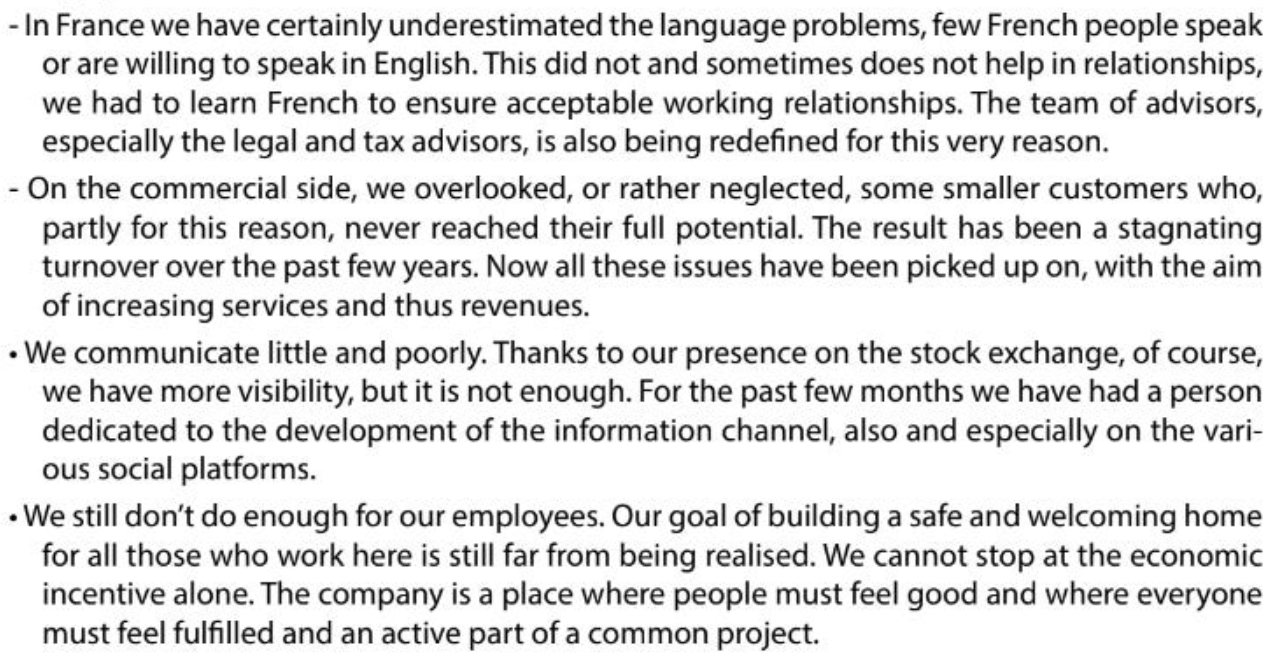
But I like this quote too:
“[…] it’s a mirror of life itself: full of setbacks and comebacks, missed trains and new ones arriving. We’ve always lived with uncertainty, which is why I’ve kept my distance from those who offer false certainties.”
This isn’t hollow rhetoric as it reflects Lindbergh’s history of adapting to its environment. Lindbergh was founded in 2006 on a mere €5k when co-founders Marco Pome (Chairman) and Michele Corradi (CEO) butt heads with both their backgrounds in European industrial logistics (Pome at DHL and HP and Corradi at Steer Davies Gleave) to start a logistics consultancy for businesses needing their expertise. It didn’t remain a consultancy for long, however, as the company pivoted with client demand, first into micro-waste, with Pome himself leading the first waste disposal. The first drivers were hired in 2009, and national contracts for forklift waste followed in 2010. In-night delivery was then launched in 2013 when Lindbergh started out as a consultant/subcontractor of TNT. (You know what happened subsequently.)
By 2019, Lindbergh expanded across the border to France via Temex, a joint venture with Globe Express, which was sparked by a Junghenrich France contract tender. Starting with a 25% stake, Lindbergh took control of the JV by mid-2021, rebranding it Lindbergh France in the midst of the entity bleeding cash. The French market, 2-3x larger and more client-concentrated than Italy, let Lindbergh serve 3,700 technicians by 2021 — nearly double its 1,900 in Italy.
So if you a few minutes ago scratched your head over the low-20s EBITDA margin I showed earlier, wondering why it didn’t match with headline figures…
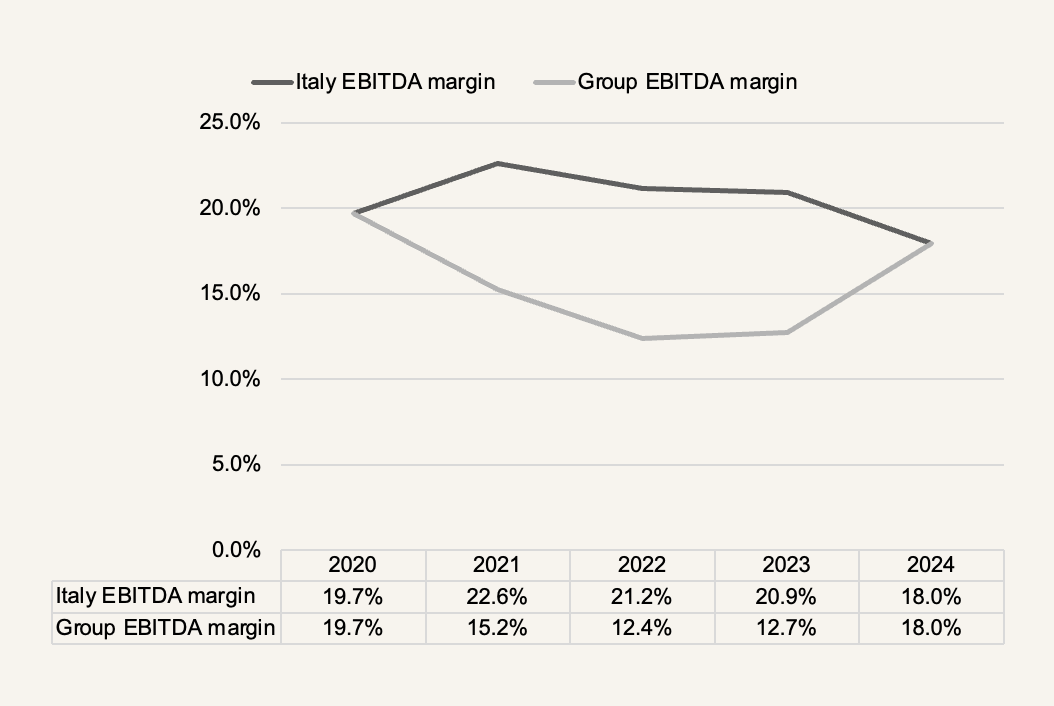
…France mostly explains the gap, because I stripped France (which Lindbergh exited last year) from the consolidated figures. Entering France was a big but expensive swing, leading consolidated margins to nosedive, and perhaps causing the market to deem the company more cyclical than is the case just by glancing over the 2021-2023 period. Lindbergh tried everything: outsourcing drivers first, then building out the distribution network, rationalizing suppliers, onboarding and synchronizing T-Linq, then slashing costs. Corradi even pulled his Italian roots to relocate to France for six months, learning the language. But faced with more competition than in Italy from the likes of Sterne and Ciblex, efforts barely tipped to critical mass before management decided this was too hard and pulled the plug, selling off the business unit in 2024 to Sterne for pocket change at an expected consideration of €1.2-1.5mn, or 0.13x trailing sales (vs Lindbergh itself currently trading at 1.8x).
There are two ways to view the French venture: It was a mistake, a costly one at that. (Just in FY21, when Lindbergh fully consolidated the JV, capex including leases and intangibles jumped to >€4mn, up from ~€400k in FY20.) Yet, since Lindbergh took over the money-bleeding JV, management still pulled off an EBITDA margin improvement from -14.4% to 0.4% by FY23 and was despite sunk costs and commitment bias rational enough to dispose of the unit when realizing it couldn’t replicate the Italian business. This takes discipline. As Corradi put it:
“I’ve said many times that selling is harder than buying, especially when you’ve invested so much, believed so strongly, and lost sleep hoping it would work. It wasn’t easy, especially knowing that part of our investment would be lost, and knowing some of you invested in Lindbergh with the specific hope of international expansion. But I can say, with full peace of mind, that staying would have been riskier — locked in a price war with an aggressive competitor. I don’t know if divesting was the right choice, but I do know it was a coherent one. Coherent with our principle of not exposing the Group to disproportionate risks that could compromise our financial stability and investment capacity.”
This isn’t the only time shareholder value has been prioritized over empire-building. Management could have just as easily doubled down on France to speed up the network, acquiring companies to consolidate the structure, but it didn’t. Separately, a couple of years back, large clients tried to convince Lindbergh to go into the general waste management facility business, but management declined to go into a commoditized service facing price wars with large waste managers. Instead, Lindbergh took the idea and tweaked it to start a circular economy business, landing a 3-year agreement with LVMH to enhance sustainability and traceability of recycled materials in the luxury sector. Rational decisions like these are only enabled if you have a management team with risk-taking experience and skin in the game, intending to build their wealth through perpetual ownership and not giving a hoot about the ticks of the share price. 41% of the company is owned by insiders, of which the two founders own a collective 30% and the three other main managers — all with +15-year tenures — own the other 11% (all acquired around 2010). Pome and Corradi each take a modest €95k per year salary (no bonuses), and the other three managers follow suit, drawing below-market pay. Of course, as if the system was ripped from Thorndike’s “The Outsiders“, it hasn’t gone unnoticed by Thorndike himself as well as Christian Solberg, who, through their fund, Sun Mountain Partners, acquired a 3.9% stake in the company in January 2024. Pome facilitated this by selling part of his shares, sidestepping a 36-month post-IPO lock-up to bring in heavyweight aligned investors who could add strategic heft, particularly on capital allocation. (The market cheered when Thorndike’s stake was disclosed, with the share price jumping 12% on the day.)
Anyway, the whole France saga wasn’t Lindbergh’s only bold bet since raising a bit of capital in the 2021 IPO (€4.5mn from the listing, plus €2.7mn from the exercise of IPO-issued warrants in December 2024). Inadvertently, the French venture sparked management’s next pivot. While in France, Corradi had observed how Bosch had been consolidating HVAC technicians all over the country, rolling up small players into a dominant network, and envisioned a parallel opportunity back home. Corradi figured that Italy, together with France, is at the very top of the most fragmented HVAC markets in Europe, being a patchwork of 12k mostly family-run shops with 5-10 technicians, servicing a €12bn industry dispersed by geography and specialty. So in 2023, Lindbergh launched SMIT Srl as a fully-owned vehicle to roll up succession-challenged HVAC firms, aiming to become Italy’s first national B2C thermohydraulic maintenance and installation player. And it’s been busy, refunneling cash flows from the moaty network+waste/circular business into serial acquisitions:
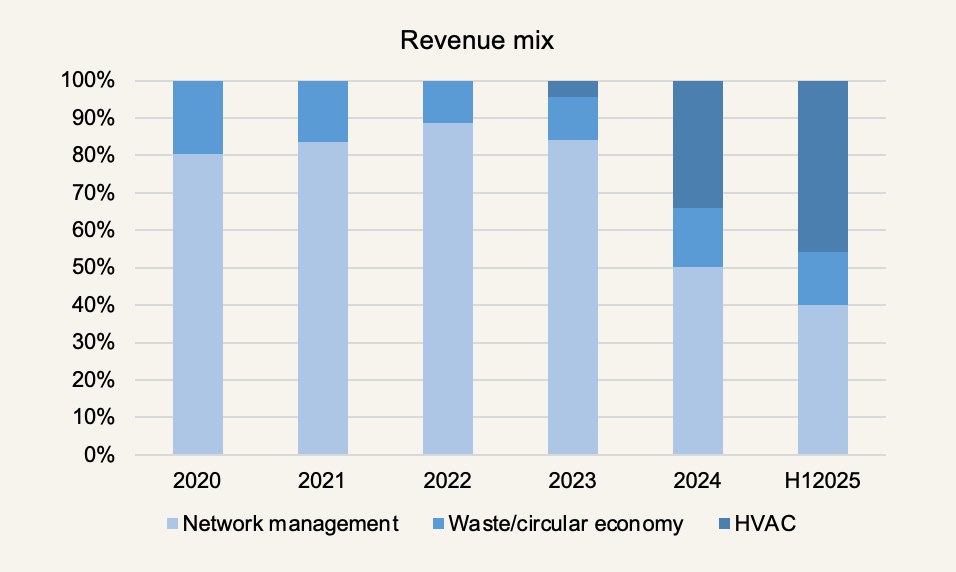
There have been no hiccups so far. The acquisition spree kicked off in February 2023 with a 52% stake in SMIT itself, a Piazneza-Parma firm focused on plumbing and boiler maintenance, which was later raised to 100% when owners cashed out. Fast forward to today, SMIT has acquired 11 HVAC companies, adding 67 field technicians and 39 back-office staff to the payroll. These deals, targeting firms with over 10% EBITDA margins and a long history of audited financial statements, typically close at a disciplined 3-5x EBITDA using cash and debt (at 1.5x EBITDA turns) and a time-deferred payment plan funded by positive cash flows of the acquiree. These multiples have so far impressively come down to something like 2.5x post-synergy (by centralizing ERP, warehousing, and back office) as Lindbergh has consistently been able to lift margins by 3-5ppts over a couple of years of ownership. (SMIT earned a 15.4% EBITDA margin in FY24.)
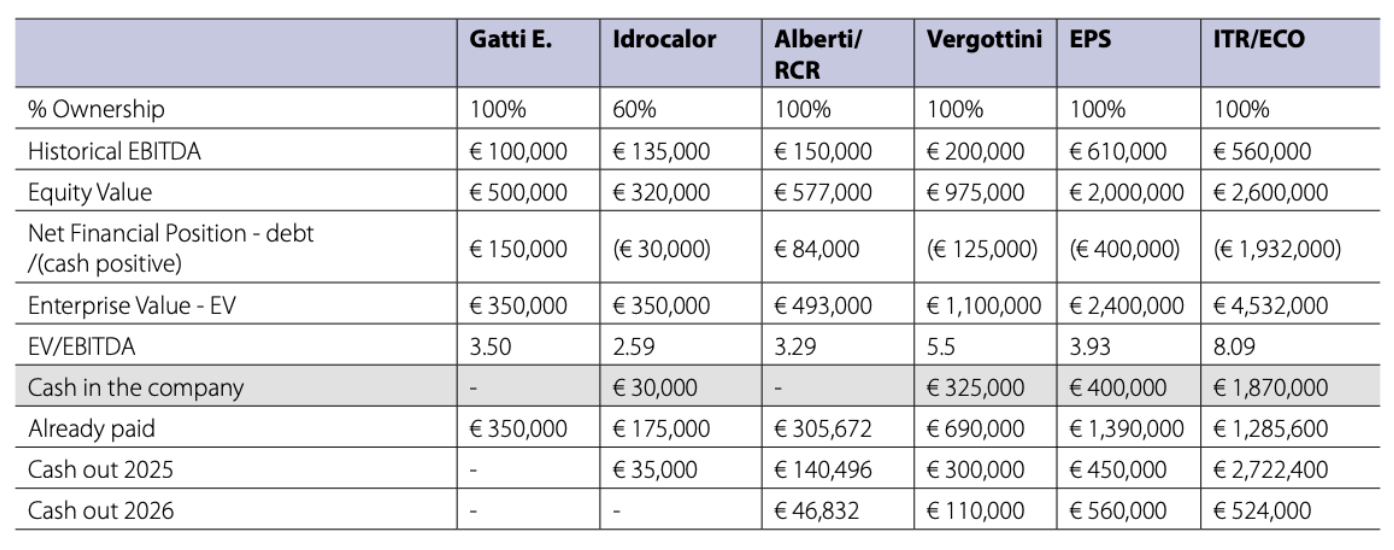
Potential acquirees are scouted by SMIT’s operational director, plus two former owners of acquirees, mixed with external M&A brokers. Lindbergh aims for platform acquisitions in each Italian region, serving as springboards for organic growth and bolt-ons. For potential acquirees passing filters, Lindbergh meets with the companies to gauge the technicians’ willingness to work with a new owner and to scout who may be a suitable candidate to take over as manager. (The previous owner usually stays for a while to ensure a smooth transition, but since these family-owned companies typically come up for sale during succession planning, the manager must be replaced at some point.)
Even as this new growth arm is certainly distinct from Lindbergh’s historical business (and doesn’t, as you may wonder, cannibalize the existing client base which doesn’t really include HVAC OEMs), with nowhere near as strong entry barriers, you could argue that Lindbergh has quite a back-office and logistical advantage in pulling this off — perhaps enough to compete effectively with any salivating PE firms eyeing the space. Unlike most other markets, for some reason there hasn’t been a massive influx of PEs into Italian HVACs (yet). My hunch says that Italian family-owned businesses are fiercely family-oriented and would resist selling to any transactional owner if they can, making this a relatively unattractive market for corporate flippers. In and of itself, HVAC is attractive for consolidation since these are stable (annual maintenance mandated by law plus customer inertia), cash-generative businesses that require low capital investment, operate in a growing, fragmented industry run by baby boomers entering retirement, and synergize easily via duplicated back-end cost takeouts.
“Becoming a leading national player in the HVAC industry does not just mean leading in terms of numbers and market shares. Our goal is not to simply aggregate revenues from the companies we acquire. We aim to play this game in a new way. In a short time, we’ve built a strong foundation: companies from different regions, with different skills and expertise, and clients ranging from B2B to B2C. We know — because it’s what we do every day — how to make operations more efficient, increase technician productivity, and improve customer satisfaction. We want to stand out and be recognized for value-added services, sold with modern, effective sales approaches.”
With a massive pond and few buyers come low deal multiples. And Lindbergh’s HVAC margin uplifts speak for themselves. So it should come as no surprise that pivoting from the French venture to Italian HVAC rollup has so far been a savvy move, underpinned by incremental returns on capital:

At these deal numbers, the balance sheet is no hindrance, even as Lindbergh expects to acquire €1mn of EBITDA annually, coming out to a spend of some €2.5mn post-synergy. That’s more than its €1.4mn trailing FCF (excluding change in working capital) but should be more than sustainable with a growing FCF and a wide spread between current 0.6x ND/EBITDA and management’s (conservative and self-imposed) 1.5x limit. Assuming that 40% of EBITDA converts to FCF at targets, these deal multiples equal a 16% day-one post-synergy ROI plus organic growth per deal. If you asked me, without knowing of Lindbergh’s deal numbers beforehand, whether I would want Lindbergh to pivot from its network+waste/circular business into an HVAC rollup as opposed to buying back stock, I sure would have said “no”, but these M&A economics are pretty hard to argue with.
But as I’ve said before, serial acquirers, hostage to a lucrative deal environment, do not come without risk. Unlike the networks management business, HVAC hardly strengthens with scale, especially in light of needing to keep track of a sprawling group of local project businesses. The pivot also makes Lindbergh more cyclical, with a recession hitting harder than the moaty network+waste/circular business alone. Plus, Italy’s field service engineer supply is tightening, potentially curbing growth and raising staff costs. While this is a net positive for the network+waste/circular business, with the effect being that OEMs push to increase the productivity of their existing engineers, for Lindbergh’s HVAC business it’s not, because these engineers are directly on Lindbergh’s payroll and organic growth depends on attracting more of them.
On the other hand, even as the HVAC business is largely commoditized, with low entry barriers and little to no price difference between providers, the reason why HVAC markets are so fragmented to begin with is that it’s hard to steal customers. Local HVAC businesses largely get entrenched through word of mouth. Scaling is tough, which is what paves the way for consolidation. Plus, the secular trend as it relates to environmental standards (like, for instance, from 2027, only certified technicians will be allowed to work on HVAC systems at any time) is a tailwind.
For this two-sided business — one moaty with moderate growth and one rapidly growing but less defensible — you’re paying a slightly above-average 19x EV/EBIT versus a 15x median for the whole Italian market, but if you adjust for acquired intangibles to get closer to Lindbergh’s real maintenance capex, the multiple jumps back in line with the median. That’s certainly attractive given the reinvestment returns and runway. If I weren’t a penny pincher and quite wary of jumping into just about any serial acquirer dependent on a deal environment not changing dramatically, I’d say that the below assumptions look plausible and that one, provided no hiccups, could make some money here. (My assumptions include 1ppt margin expansion/mean reversion in network+waste/circular to keep things simple, though you could argue that this is conservative and that revenue per technician-driven growth in the mid-single-digits percentage should add further operating leverage.)
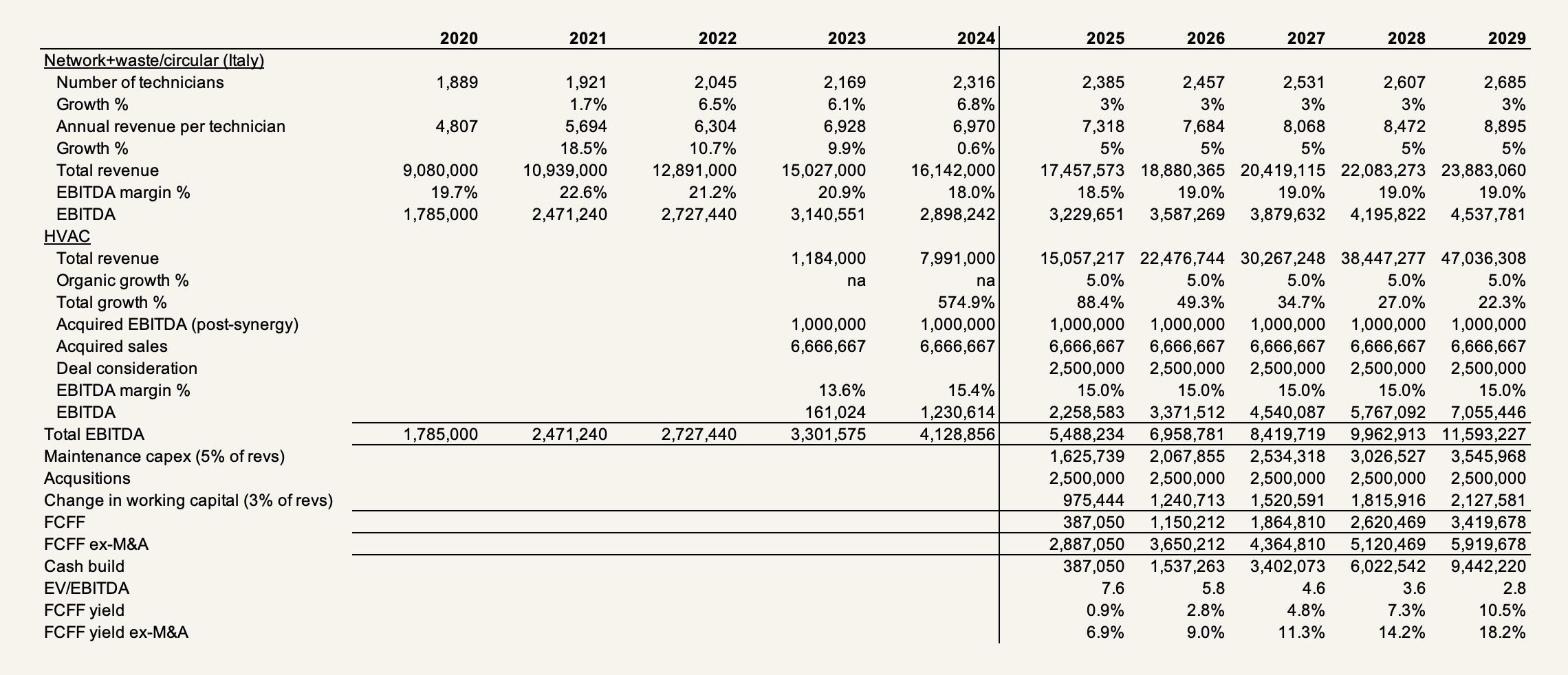
On 8x EBITDA in the out-year (FY29), the enterprise could be worth €93mn, yielding a potential ~22% total return CAGR, including cash build, at today’s price. I can certainly appreciate how the stock might look attractive here if management doesn’t roll over on its rollup strategy.
Importantly, Lindbergh isn’t chasing attention. Only recently, the year after the 2021-IPO, did Lindbergh start communicating with the market in English. Even the prospectus is only available in Italian. The float is also small at 4.5mn shares, with ~€50k traded daily. The stock is listed on Euronext Growth Milan, meaning it’s off the radar for most institutions and could add a kicker once Lindbergh grows into an eventual uplisting to Borsa Italiana.