
Following my rant on net nets last week, I promised you a follow-up writeup on Deswell Industries, a net net. Here it is. It’s a compelling setup, the rare “good” kind of net net, but it’s got some hair.
Deswell is a contract manufacturer for OEMs and other contract manufacturers. Its business splits into two segments with little overlap: plastic injection molding (~20% of revenue) and electronic products and assemblies (~80%).
The plastic injection molding business makes components for consumer and industrial use: think handles for power tools, outdoor gear, or flashlights, and casings for phones, printers, scanners, blood test devices, or robot vacuums. The process starts when a customer sends Deswell its specs, after which Deswell’s technical team draws up a precise CAD design and crafts a mold with meticulous attention to detail, refining the sample until all flaws, such as sinkage or irregular knit line of the joints, are eliminated. This onboarding process takes a full 30-50 days, is capital-intensive, and requires specialized equipment like Deswell’s 10 electrical discharge machines (EDMs), 14 CNC milling machines, and 10 numerical control (NC) milling machines. Customers foot the bill for the molds, costing ~$9.2k per set. Then, with ongoing production agreed and set up, Deswell sources the appropriate plastic resin from one of its many suppliers and mounts the finished mold onto one of its 130 injection machines, which have 86 to 1.6k tons of clamping force and run 24/7 in shifts to produce everything from tiny buttons to 3×2-foot copier cases. Some machines operate in dust-free zones for high-appearance products like calculators or phones. Finally, Deswell finishes up the components through manual smoothing, polishing, silk screening, pad printing, and anti-fog coating to ensure durability and aesthetics, ready to be shipped to the customer’s warehouse or shipping hub.
The electronic components and assembly business is different. It produces professional audio gear, such as mixers, amplifiers, signal processors, audio interfaces, and speakers, and handles printed circuit board assembly. Deswell also makes medical products, IPBX and commercial phone units, IP switches, and routers. But circuit board assembly is Deswell’s core strength, leveraging surface mount technology (SMT), pin-through-hole (PTH), and ball grid array (BGA) techniques. SMT allows for tiny, cost-effective circuit boards with components mounted on both sides of the board, improving signal speed and reliability. PTH, an older, labor-heavy method, is used primarily for consumer products. BGA supports denser, more complex circuit boards.
Unlike consignment manufacturing, where customers supply the parts, Deswell’s offers customers a turnkey solution, handling everything from material procurement to design to development. This piles inventory risk and capital costs onto Deswell, but Deswell’s knack for circuit board design and mold-making adds value for OEMs seeking high-quality, low-cost solutions. Customers get faster time-to-market, less capital tied up, and lower inventory risk. Shrinking product life cycles of consumer goods make outsourcing to folks like Deswell increasingly appealing.
I dragged you through this long intro to show you how you can easily be fooled by elaborate business descriptions into thinking any company can be a unique slowflake with a durable moat. We tend to overindex storytelling, seduced by technical jargon, convinced there’s something proprietary or defensible in the pitch we hear or the investor presentation we watch. But peel back the glossy details, and a company like Deswell’s reality is less romantic. It’s not reinventing the wheel. It’s churning out plastic parts and circuit boards in a crowded field with scant differentiation.
And oh, by the way, Deswell is Chinese. So while the actual key value proposition of OEMs outsourcing to Deswell or other Chinese contract manufacturers is access to low-cost labor and long working hours (Deswell has dormitories for its workers — tactics Western contract manufacturers can’t pull), this doesn’t shield any local player from fragmentized, local competition. Competition is heating up in Vietnam and India, and, especially in circuit boards, in Taiwan. Turnkey offerings sound impressive, but they’re table stakes in contract manufacturing, with every player worth they’re salt offering similar services to stay in the game. In a world of razor-thin margins, betting on the ability to deliver reliable parts for OEMs while shouldering most of the capital cycle risks is a tough game to win. Deswell’s technical prowess and operational hustle are legit, but they don’t translate into a sustainable competitive advantage when every local competitor has the same playbook and customers can easily jump to or dual-source from the next cheap provider. Deswell has no long-term supply contracts with its customers, whose top two take up 34% of sales, a figure that has fluctuated a lot in the past. And its gross margin swings wildly, hostage to plastic resin prices tracking oil prices (a derivative from crude oil refining) and the availability and long lead times of electronic components, both tough to pass onto customers. So while the business description may sound appealing, it’s just that: a story, not a moat.
With this in mind, Deswell’s business has been a rollercoaster since its founding in 1987. Pre-GFC, it earned excellent returns on the underlying business, surfing China’s outsourcing boom when there was enough cake for everyone. But as with many other Chinese manufacturers, the GFC marked a turning point for Deswell, with sales plummeting from a high of $143mn in FY08 (Deswell’s fiscal year ends on March 31) to $38mn by FY15, mostly driven by retracted volumes from a couple of large customers (Digidesign and N&J Company) whose own sales tanked. A hodgepodge of demand shocks, rising labor costs, intensified competition, supply chain issues, regulatory pressures, and negative operating leverage took profits on a tailspin and pulled an okay gross margin in the low 30s in FY04 down to ~11% by FY15. From then on, Deswell started seeing gradual upticks in sales, now reaching $68mn by FY25, but even though Deswell has ridden a depreciating RMB (in which it pays most labor costs) against the USD and HKD (in which it generates most sales) over the full period from 2015 till today, margins never recovered to their former glory. Operating profits have improved with scale and restructurings, but are still a way off the 2000s peak, a level which they’ll probably never reach again. This long history is key to sizing up Deswell as a net net. Here’s its sales and returns on capital going back to 2001:
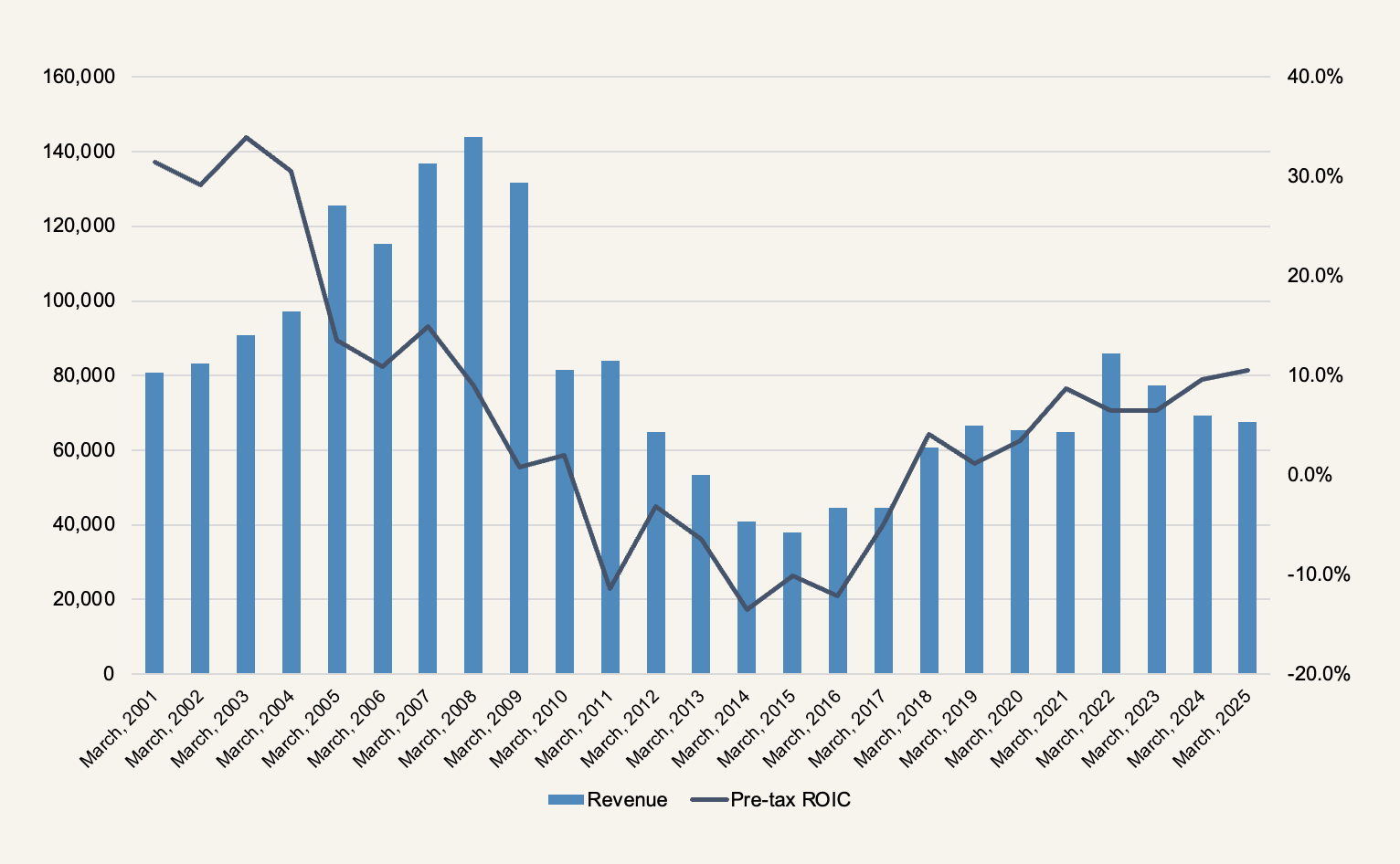
Despite digging itself out of its 2013-2017 slump, and following up with acceptable returns on capital in the recent half-decade, the stock today trades as a net net. This is Deswell’s balance sheet as of March 31, 2025: