
For years, I’ve told myself to shy away from opining on Bitcoin in the public sphere. This is partly due to a lack of detailed technical acumen about blockchain mechanics and decentralized finance versus the fiat system (a critique Bitcoiners often throw at others, though many join the bandwagon), and partly because I don’t want to poison the discourse with my readers. Bitcoin opinions, positive or negative, tend to ignite like a match in a room full of fireworks.
But after being unable to avoid reading about the craze surrounding so-called Bitcoin treasuries, I can’t help but point out how asinine it all is. (I’m using “Bitcoin treasury” since it accentuates the point that it’s overwhelmingly the asset held in these entities, but this phenomenon covers all cryptocurrencies.)
In case you’ve missed the financial news, Bitcoin treasuries (some call them “digital asset treasuries,” or “DATs”; others dub them “crypto holdcos”; still others abbreviate them to “BTCOs”) are simply companies that buy Bitcoin and park it on their balance sheet. Any company could do this, but the point is that a pure-play Bitcoin treasury shouldn’t have much of an operating business attached, making the entity a vehicle to “invest in” (or rather “hold”) Bitcoin through a corporate wrapper. From online casinos to digital health technology companies, to video game retailers (yes, GameStop), to the POTUS himself, dozens of new Bitcoin treasuries launch weekly, where simply holding Bitcoin weeds everything about its actual business out of the discussion. Holding Bitcoin becomes the corporate strategy.
If you, while choking on your coffee, say, “So what? Investors plunge into schemes like this all the time,” you’d be right. But this trend amalgamates every crazy market fad since 2020 — SPACs, meme stocks, pump-and-dumps, fartcoins — into a single, more dangerous financial construct that’s now blatantly promoted by the US Administration. The result is that demand vacuums up every new Bitcoin treasury that emerges, regardless of the quality or integrity of the underlying business or sponsor. Over 160 publicly listed companies today hold Bitcoin for a collective >$110bn (see the list here), with 2025 shaping up as the blow-off year.

Demand for these vehicles from retail investors and institutions alike is so fierce that a single company PR announcing a pivot — or abandonment of building an actual business — into a Bitcoin treasury frequently causes the share price to explode far above the company’s NAV, consisting mostly of Bitcoin holdings. So what happens is that the stock market will pay anywhere from $2-4 (or more like $1.5-6) for every $1 worth of Bitcoin, purely because it’s encased in a corporate structure.
This newsletter isn’t a defamation of Bitcoin itself. It’s not my place to quibble with why people hold Bitcoin, whether as “digital cash,” a bet on future adoption, or a greater-fool trade. I could argue that Satoshi Nakamoto’s utopian vision of liberating finance and shielding individuals from expropriation and inflation has been butchered by Bitcoin’s main use case devolving into facilitating fraud, money-laundering, and other financial crimes, becoming what The Economist describes as “the ultimate swamp asset.” I could contend that Bitcoin’s intended role as a currency rests on the shaky assumption that constant deflation is ideal, but such a regime would inflict economic hardship, eroding living standards for most people who lack the advantages of merchants or creditors. I could note that reverting to a regulatory regime without national deposit insurance fills me with more doom than liberation. I could point out that the gold standard ended because most people hated it. Or I could say that Bitcoin’s long-term “value” as an inflation hedge is surpassed by assets with actual cash flows and less volatility.
But I’m not going to do that. Instead, this is about the stupidity of Bitcoin treasuries trading above NAV, the ridiculousness of promoters’ arguments for why they should, and the perverse incentives on both sides of the trade — with promoters deserving the lion’s share of blame. Spoiler: Bitcoin treasuries aren’t escapes from fundamental value.
Before diving into why Bitcoin investors prefer an institutional hand-holder over their own wallet — contradicting Bitcoin’s ethos — let’s start with the promoters.
“Show me the incentive and I’ll show you the outcome”
Taking the fundamentalist view of Bitcoin as an alternative to cash, with the notion that Bitcoin evangelists view every asset denominated in Bitcoin as opposed to fiat (“It’s everything else that’s volatile, not Bitcoin”), there was a time not long ago when corporate cash served to cover corporate needs. Cash lubricated daily operations — change in the register, vendor payments, petty expenses — with excess returned to stakeholders via debt repayments, dividends, or buybacks. There were exceptions concerning “opportunistic cash”, set aside for eventual economic downturns or as a buffer for a money-losing growth company, or “stranded cash”, where repatriating cash held offshore would lead to heavy tax hits. But generally, companies held as little cash as they needed to run the business.
For Bitcoin treasuries, it’s inverted: the business is a fig leaf for hoarding more Bitcoin, with operations serving as a means to justify and fund Bitcoin acquisition. But Bitcoin isn’t opportunistic cash, and hoarding it means forgoing its use as a lubricant. Swapping low-volatility cash for high-volatility, risk-on Bitcoin makes for less of a cushion in downturns. And it undermines proper corporate governance, where companies return excess cash to shareholders and let it be up to them how they wanna reinvest it. If you, as a shareholder, believe Bitcoin to be the asset to hold, you should buy it yourself from the dividends paid out of the company’s cash-flow-generating operations. Giving managers the power to hoard Bitcoin, cryptocurrencies, or other collectibles, where disclosure and audits are scant, invites self-dealing and power abuse. Managers of Bitcoin treasuries, left with sinister opportunities, won’t care about all this, as their incentives diverge from yours. (Real-world corporate governance is more cynical than what you learn in textbooks.)
The whale of Bitcoin treasuries is Strategy — formerly MicroStrategy — led by Michael Saylor. He pioneered the model, having now amassed 630k Bitcoin (as of Q22025), or 3% of all Bitcoin ever to be in existence. Back when it was MicroStrategy, it focused on BI software, analytics, and mobile platforms, scoring prominent deals with DuPont and McDonald’s while founding and flipping sites like Alarm.com in the 1990s. By late 1990s, it got swept into the dot-com bubble, peaking at $24bn market cap on $140mn revenue in 2000. But an accounting scandal restated 1998-1999 financials, cratering the stock 62% in a day and vaporizing much of Saylor’s estimated $6bn fortune. The SEC charged the company, Saylor, and other execs, who settled with fines without admitting wrongdoing. MicroStrategy lived on, growing through the launches of OLAP Services in 2009, smartphone apps in 2010, then cloud services. By 2014, however, lackluster performance pitted it against Microsoft, IBM, and Oracle. Saylor reduced his salary to $1.
After half a decade flailing for growth, MicroStrategy reinvented itself amid 2020’s crypto mania. In August 2020, it became the first publicly traded US company to adopt Bitcoin as its primary treasury reserve asset, starting with a $250mn purchase, with the reason as a way to protect the company amid macro concerns during the pandemic. To Saylor, this wasn’t an abandonment of the core BI business but a treasury strategy to hedge against a weakening dollar.
With help from ZIRP and a volatile stock, Saylor discovered he could issue 0% (or close to it) convertible bonds to fund further Bitcoin purchases. If you ask why Saylor wouldn’t just issue equity instead, the answer is that the convertibles were issued at a premium and wouldn’t dilute the share count before they came in-the-money. That’s when he found his masterstroke: To keep being able to raise money to fuel his newly-discovered perpetual motion machine, in marketing newly issued Strategy securities at premiums to the share price, he, ironically, had to borrow a term from conventional finance which Bitcoin certainly lacked: yield.
“Bitcoin yield” is not to be confused with the yield earned on your cash flow-generating assets. No, Bitcoin yield is the period-to-period percentage change in the ratio between the company’s Bitcoin holdings and its diluted shares. In other words, it’s the change in Bitcoin per share. But it’s a smokescreen — another way to say that new investors fund “yield” for old investors. The yield that reaches old investors comes straight from newcomers’ pockets. Because the “Ponzi” label has been thrown around Bitcoin forever, this is easily brushed off by Bitcoiners. But here, it fits not Bitcoin itself. Ponzi, in this case, is the definition of how Strategy and other Bitcoin treasuries operate: publicly boasting Bitcoin yield as shareholder value, while obfuscating the fact that the yield stems not from any operations but from new investors hoping to get a high Bitcoin yield themselves.

The size of the harvest of new investors’ hard-earned savings is proportionate to the scale of confusion (measured by the size of the premium to NAV), fueled by financial engineering, promises, and guru evangelism.
To make the smokescreen even smokier, Saylor wasn’t done with financial alchemy. Adding to shareholder confusion of how Strategy creates value (hint: it doesn’t), in January 2025, Saylor added perpetual preferred stock to the capital stack, finalizing its first prospectus for its “Strike” issue. 7.3mn Strike shares were issued with 8% cumulative dividends on the liquidation preference of $100 per share. In practice, this meant a $2 per share quarterly dividend in perpetuity, or until the shares convert to Strategy common stock at a 10:1 ratio in the case of the common hitting $1,000 per share, making the issue a dividend-paying perpetual call option on the common stock.
Confusing? Don’t worry — Strategy’s investor presentations got you covered. “Growth-oriented income to investors seeking Bitcoin exposure with yield protection” is how Strategy described the issue, after which the company then compares the “yield”, i.e. the cumulative dividend, to the effective dividend yield on the S&P 500, Nasdaq, and commercial real estate from which dividends are paid out of actual earnings. Though this is Saylor’s way of saying, “Trust me bro”, through financial gibberish, promising a varied risk/return profile to investors, it goes without saying that the preferred issue is just another way to skim the same cream. The dividends would, again, be paid from the harvesting of future sheep. It’s no surprise that the preferred included a term allowing Strategy to pay dividends in the form of newly-issued common stock if needed.
By March, Saylor stepped harder on his agenda, publishing a new prospectus that enabled Strategy to issue up to $21bn worth of Strike preferred stock, then followed by yet another preferred issue by the close name of “Strife”. While this one had no conversion right, it was senior to both the common and the Strike preferred and had an escalating dividend protection of a 1% increase per missed payment until an 18% cap. Two more preferred issues would soon follow, Stride and Stretch, with the former junior to every other instrument except the common, and the latter “designed to promote stable price dynamics” through a variable dividend.
The real reason for all this financial engineering has always been to acquire more Bitcoin through postponed dilution, while giving retail investors the impression that Strategy would increasingly cater to trillions of $ in institutional ponds. And so as investors, wowed by Saylor’s illusory financial innovation, mindlessly glorified Strategy’s carefully curated narrative, they forgot to ask themselves from where and how their Bitcoin yield was created, allowing Saylor to continue his flywheel.
Other than adding to shareholder confusion to fuel the premium to NAV and to enrich himself, Saylor had another incentive too: in order to keep pace, he had to make sure the Bitcoin price kept appreciating. With the playbook firmly in hand, he preached to get other companies on board, funneling further capital from the real world into a supply-constrained Bitcoin, while justifying his motives by not going solo.
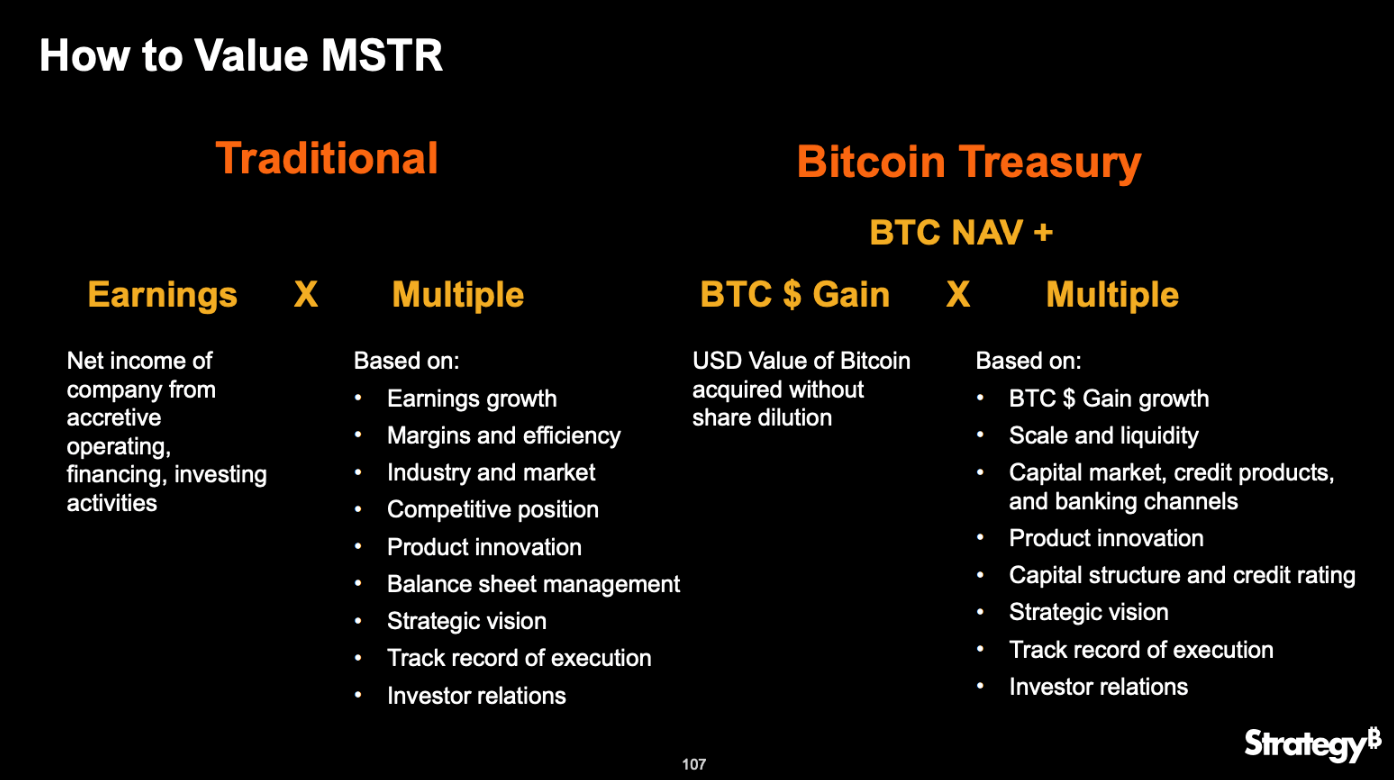
So Saylor went about presenting nonsensical, having-your-cake-and-eating-it-too valuation slides like…
…and misleading ones comparing mark-to-mark gains with recurring earnings like…

…plus endless podcasts and interviews, masking these marketing efforts as a public service. But it worked, and the massively successful concept of “Bitcoin yield” spread like wildfire among small-cap executives, who, themselves fighting like hell to raise just a bit of capital, watched Strategy insiders become immensely rich by continuously dumping shares onto retail investors. (Saylor himself admitted once that he was desperate before stumbling upon Bitcoin.)
Many of the zombie companies, persuaded by the promise of easy money and good ol’ wealth transfer, pulled it off — perhaps to their own surprise — enriching insiders in the process.
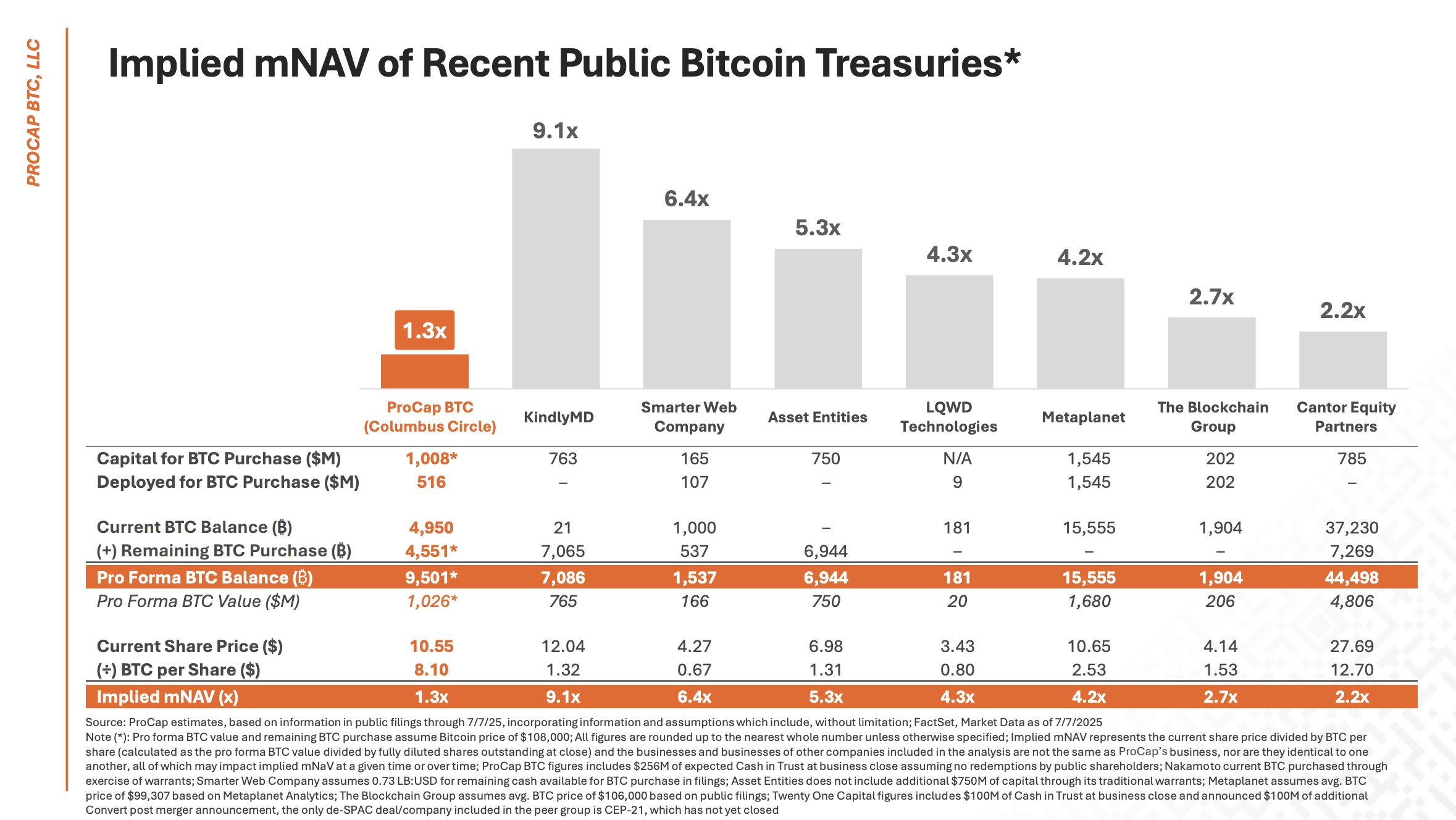
Metaplanet, formerly known as Red Planet Japan, is a former budget hotel operator in Japan turned aggressive Bitcoin treasury. Since pivoting in 2024, it has expanded its share count by some 400%, with the market cap reaching almost $7bn at its peak from $13mn, currently priced at 2x its Bitcoin holdings. Metaplanet counts Eric Trump, the son of the US president, as strategic adviser.
While The Smarter Web Company, a web designer, isn’t the first and only UK-listed company to do this (there are about a dozen), it certainly was a pioneer. Shortly after its shares were admitted to trading on the Aquis Stock Exchange in April this year, the company announced a 10-year Bitcoin treasury plan. From a market cap of GBP3.7mn at the time of listing, shares of SWC quickly exploded past GBP1bn (now sitting at GBP550mn).
And unsurprisingly, the POTUS jumped on the bandwagon too. After minting a monumental amount of money and legalized bribes from launching $Trump coin three days before inauguration, the President wasn’t done squeezing crypto. Trump Media recently raised $2.4bn to buy Bitcoin, modelled after Saylor’s blueprint (and personally recommended to the Trumps by Saylor himself), which followed the President’s establishment of a US Strategic Bitcoin Reserve that currently holds 200k Bitcoins. The President owns 40% of Trump Media with an implied market value of ~$2bn. The following is what CEO of Trump Media, Devin Nunes (yup, that Nunes) said in the offering PR — what a world we live in.
“We view Bitcoin as an apex instrument of financial freedom, and now Trump Media will hold cryptocurrency as a crucial part of our assets. Our first acquisition of a crown jewel asset, this investment will help defend our Company against harassment and discrimination by financial institutions, which plague many Americans and U.S. firms, and will create synergies for subscription payments, a utility token, and other planned transactions across Truth Social and Truth+. It’s a big step forward in the Company’s plans to evolve into a holding company by acquiring additional profit-generating, crown jewel assets consistent with America First principles.”
The list goes on, with the one thing in common that these companies were desperate and had nothing to lose before pivoting to Bitcoin treasuries:
- Bluebird Mining, a struggling UK-listed gold miner plagued by continuous operational delays.
- Meliuz, a Brazilian cashback business that right before pivoting had done a 100:1 reverse split.
- Semler Scientific, a small US medical device supplier who by its own Chairman was described as a “zombie company.”
- Vanadi Coffee, a loss-making Spanish coffee shop and bakery threatened by bankruptcy.
- KULR Technology, a loss-making US thermal energy company struggling with market traction.
- H100 Group, a small, struggling Swedish biotech in dire need of cash.
The latter, H100, follows a trend of small, struggling companies getting gobbled up by crypto entrepreneurs. (If you’re a crypto entrepreneur with a big pile of Bitcoin, why would you sell your pile on the Bitcoin market when you can package your pile into stock and sell it at a 100% premium?) In the midst of this, though, there have been glimmers of sanity. LQR House, a tiny liquor company out of San Diego, CA, which already owned ~$1mn worth of Bitcoin, was last month subject to a hostile takeover by crypto entrepreneur Robert Leshner, who planned to replace the Board and help it “explore new strategies”. The Board would have none of it and started to sell a ton of stock to take Leshner below majority ownership.
But now, with the revival of SPACs, crypto entrepreneurs again have a lucrative, albeit slightly stigmatized, avenue to mark up their piles, without having to take over existing shitcos. Cantor Fitzgerald has been a happy blank cheque provider in two SPAC deals, one with Twenty One (a venture between Tether and Softbank), merging with Cantor Equity Partners (run by Brandon Lutnick, son of US commerce secretary Howard Lutnick), and one with Bitcoin Standard Treasury Company, merging with Cantor Equity Partners I. The latter has Blocksteam, led by Adam Back, in common with H100 as backer and provider of Back’s Bitcoin pile.
Anyway, let’s now look at this from the investors’ point of view.
I hear you: “Surely, the market in the aggregate can’t be this dumb. Look at Strategy, which has ~13k institutions and 800k retail shareholders in its shareholder register. Are you sure you’re not missing something?”
Of course, not all investors are ignorantly piling into Bitcoin treasuries. Strategy is completely transparent about what it does and how it intends for its share price to go up. Apart from Saylor’s financial engineering smokescreen, no one buying into Strategy can credibly claim to have been misled by Saylor about the merits of the securities they bought. Every new shareholder knows that their investment’s prospects (in relation to Bitcoin itself) are entirely dependent on the premium to NAV continuing forever, so that it becomes the problem of future sheep.
Bitcoin treasuries go against Bitcoin’s original intention: they don’t want you to hold your own keys, they won’t publish wallet addresses, and they’re institutionally backed. So something fuels market demand for these entities to trade at a premium to Bitcoin itself, apart from investors knowingly participating in the Ponzi and expecting to bank from it (which I assume the majority of investors here are doing, and which is likely the best explanation out of the full list below).
Here are the arguments I gathered for why Bitcoin treasuries should trade at a premium to NAV:
- “Amplified Bitcoin”: This is Strategy’s main argument. Amplified Bitcoin is what I already described: issuing stock at a premium to NAV and then using the proceeds to buy more Bitcoin. If a company doubled its share count at twice the price of NAV, that’ll drive a 50% Bitcoin per share growth, or “Bitcoin yield”. Now, since Strategy and other Bitcoin treasuries do this with convertible debt and preferred stock, they essentially lever up to postpone shareholder dilution. It goes without saying that this is a brilliant idea (to old investors, not newer ones) as long as Bitcoin rises against the USD, and a terrible idea if it doesn’t.
- Accessibility: Holding Bitcoin through a corporate entity allows the digital currency to reach accounts or jurisdictions that it itself can’t, broadening the investor base. Many traditional brokerages or retirement accounts won’t let you buy Bitcoin directly, so a Bitcoin treasury may be your only play if you wanna bet your retirement savings on it. Even as the Bitcoin treasury holds your Bitcoin for you, this is still a step in the right direction for those who wish to free themselves of gouging financial institutions, putting their trust in their own investment acumen instead. In addition to iShares Bitcoin, BlackRock’s Bitcoin ETF, this accessibility through stocks has furthered Bitcoin’s exposure to institutional investors and passive flows. Bitcoin treasuries, with the public equity structure, strong narrative, and liquidity, have become the go-to proxy for Bitcoin exposure among institutions, further pushing the wave from the real world into the digital currency.
- Funding flexibility/refinement: Because Bitcoin treasuries get this easy access to institutional capital, they can issue different securities to different investors who want different risk/return profiles. With moved-around payout, dilution, and conversion features of such securities, Bitcoin treasuries can provide investors with stepped-down elements of the common stock, with lower volatility and regular payout (which means sacrificing some capital gains for getting steps ahead of everyone else in the Ponzi pyramid). This is something the iShares Bitcoin ETF can’t do.
- Tax advantage: In some countries, equity gains are taxed at a lower rate than Bitcoin gains. In some countries, crypto losses are not eligible for a tax write-off or carry-forward. And because Bitcoin treasuries are stocks, you can invest tax-free or at a tax advantage through your Roth IRA, ISA, or other local equity savings account.
- Margin trading: Equities are marginable at institutional rates, whereas Bitcoin and iShares Bitcoin aren’t, but this idea only applies to ballsy speculators and daytraders since Bitcoin treasuries by their capital structure are usually already levered (and non-recourse to the shareholder), and margin trading doesn’t affect value.
- Ease of ownership: Through Bitcoin treasuries, investors get Bitcoin exposure without needing to jump through the hoops you’d need on the Bitcoin market, setting up custody, backing up private keys, and dealing with crypto exchanges. Given that nearly 25% of all coins mined so far have been lost forever, lots of people are afraid of losing their money due to lost passwords, which is the premise of a decentralized currency. Also, if someone steals your toys, you’d cry, so it’s better to have someone you trust hold onto your toys so that whenever you want to play with them, you can (until that someone lets someone else borrow your toys and that someone else disappears with them). This ties into inheritance as well, with the risk of heirs being scammed or locked out if sticking with self-custody. The argument cuts both ways, though, where the “Not your keys, not your coin”-proposition should justify some sort of discount to NAV for truncation risk. (Note also that regulators have yet to move on Bitcoin treasuries, adding further risk which should probably be discounted.)
- Optionality: Bitcoin treasuries could, at some point, monetize all their collateral. Speculations circulate that Strategy could, once it reaches the trillions, transform into the world’s largest insurance company.
- Outsourced belief/trading: You could buy Bitcoin yourself, or you could give your money to Saylor, who promises to believe 10 times harder than you. Kidding aside, Bitcoin treasuries are increasingly scrutinized not just for exposure, but for strategy and their ability to trade Bitcoin better than average. Firms like FRNT and Hilbert Capital, both asset managers, are experimenting with trading Bitcoin and other crypto optimized for drawdowns, layering in risk management tools and AI-driven trading overlays, and targeting alpha without compromising core holdings (i.e. arbitrage), aiming to outperform Bitcoin itself. So if you think someone understands the mood and momentum of Bitcoin better than you, better to give your money to them.
I see none of these arguments as structural to the degree that they justify anywhere near a 2-4x premium to NAV. The tax advantage holds some weight, though not much more than buybacks being worth slightly more than dividends. You could argue optionality has merit too, but I find that scenario dystopian. Arguments 1 and 2 (“amplified bitcoin” and accessibility) are the main ones, but are bubble inflators entirely mistaken for premium justifiers. The good stuff coming from an appreciating Bitcoin price is primed to flip in the case of the opposite, when debt and dividend obligations remain, and something that started as a collection of narratives and exaggerations turns on its creator. Nothing here justifies Bitcoin treasuries trading above the market price of their Bitcoin holdings, since any tax advantages you may get are likely nullified by owning crypto via a proxy that is weighed by additional costs, overhead expenses, and misaligned corporate governance.
As for Saylor’s Bitcoin treasury valuation model illustrated above (Bitcoin NAV + Bitcoin $ gain x multiple), it’s absurd. The premise — that the appreciation of Bitcoin should be treated like recurring profit and capitalized accordingly — is lunacy. It’s like saying that because you expect the $500k house you live in (let’s say it’s your entire net worth) to appreciate to $550k next year, your net worth is not $500k, and not $550k, but a whole $2mn with a 30x multiple on the appreciation. It doesn’t surprise me that Saylor believes this nonsense, since he, having missed econ class 101 by the evidence of this clip, thinks that cash, which is priced at the risk-free rate, carries a cost of capital of 15% (then proceeding to botch basic math by saying 12% of $325bn is $32bn).
I wish the world would allocate its precious resources and brainpower to more productive pockets of the economy than what we discussed today. I know that’s wishful thinking. Stuff like this happens all the time, but speculation has clearly raised the stakes since the pandemic. The writing on the wall hasn’t dried yet. Saylor et al’s vision for Bitcoin treasuries is that the scheme runs far enough that Bitcoin approaches “hyperbitcoinization”: the point where sponsors believe the price stabilizes (some peg it at $10-20mn per coin). The pools of fiat are so vast that the sponsors aren’t anywhere close to running out of convincing new buyers of these products, and so are willing to floor the pedal to make these things more ingrained in the financial system. (I think you know what that implies.) It sure helps keep the scheme going when people — usually Gen Zs — run around hyping Strategy as an “infinite money glitch” and Saylor himself calling it a “quadratically reflexive engineered instrument”. (You can’t make this stuff up.)
The whole thing raises an odd paradox: How are all of the Bitcoin treasuries going to buy more Bitcoin if every big holder of Bitcoin can cash in bigger by launching their own Bitcoin treasuries? If there’s a massive wealth transfer to be taken simply by moving Bitcoins onto public markets, then everyone with a pile of Bitcoins will want that premium for themselves.
Now for what you’ve been waiting for: how do you bank on this? The answer is, I won’t. I wouldn’t short any type of absurdity in a million years — not even with long-dated options. But there are a couple of trades you could make, agnostic to where you think Bitcoin itself is going:
- You could buy Bitcoin and short a basket of Bitcoin treasuries, betting on the premium to NAV disappearing.
- If you, for whatever peculiar reason, still think that Bitcoin treasuries deserve to trade at a premium to NAV, you could buy one with a small premium and short one with a large premium, profiting from the spread closing. This could work especially if Bitcoin treasuries start consolidating through all-stock mergers.
And if you’re already long invested in Strategy or any new shiny Bitcoin treasury, the best action you can take is to copy what the insiders and promoters are doing: sell.
“On the one hand, we’ve capitalized on the most innovative technology and capital asset in the history of mankind. On the other hand, we’re possibly the most misunderstood and undervalued stock in the US and potentially in the world.” —Michael Saylor